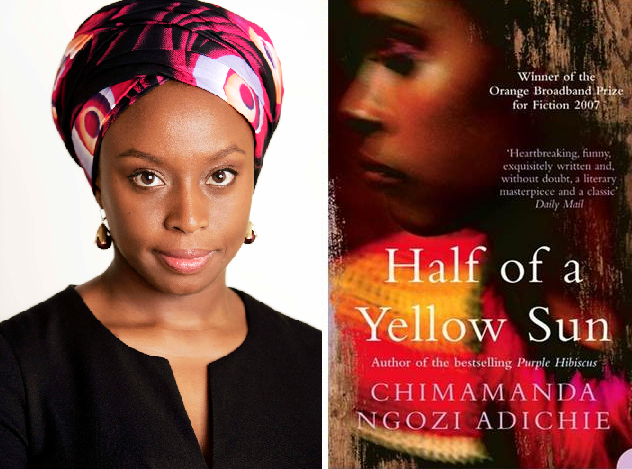
Photo: Medium
We do not usually associate wisdom with beginners, but here is a new writer endowed with the gift of ancient storytellers.
Chinua Achebe, “Chimamanda Ngozi Adichie”
Both in their life stories and as writers, Chimamanda Ngozi Adichie and Chinua Achebe have a great deal in common. Both grew up among Nigeria’s educated elite and spent much of their adult life in the United States. Both chose to write in English and belong to the growing canon of African literature. Despite their markedly different literary styles, both clearly belong to the realist tradition, write novels that deploy multiple narrative perspectives, and are adept in depicting complex characters and social situations. Both rely heavily on Igbo proverbs, language, and cultural assumptions. And both Things Fall Apart and Half of a Yellow Sun end with reference to new books relating events chronicled in the novels. Adichie’s first novel, Purple Hibiscus, even opens with a sentence that begins “Things started to fall apart at home when…” (3). Most uncanny, perhaps, the young Adichie’s family moved into a house in the university town of Nsukka that Achebe and his family had recently vacated (Anya).

Photo: Tunde Akingbade
In a strong article on “Adichie in Dialogue with Achebe,” Ruth Wenske argues that both authors exemplify a specifically Igbo “balancing of dualities,” as distinct from the more Western tendency to create irreconcilable polarities and privilege one of its terms (71). “Observing the balancing of dualities,” Wenske writes, “allows Achebe’s novels, as well as Adichie’s work, to be read as a search for balance rather than a struggle for dominance, thus conveying a reconciliatory message rather than a quest for blame” (72). In Adichie’s case, this tendency to “replace blame with a recognition of complexities and small coherences of justice,” thereby opening up new possibilities of reconciliation, has led her to be critical of Donald Trump and Trumpism, but also of so-called cancel culture, which she sees as foreclosing the possibility of learning and growth in forgiveness (Wenske 72, 76). “How much of our wonderfully complex human selves,” Adichie asked in a 2020 interview, “are we losing… [to] self-censorship?” (Allardice). Summarizing the commonalities between Achebe’s and Adichie’s novels, Wenske concludes:
The author’s focus on the complexity of individual life in a time of collective trauma leaves their novels frustratingly open, for it offers no catharsis of conclusion or absolute meaning. Yet this open-endedness accommodates the novels’ affinity to reality, allowing them to be redefined by the changes all around them without losing their integrity as advocates of morality and compassion. (85)
In 2007, on the strength of Purple Hibiscus and Half of a Yellow Sun, Achebe famously said this of Adiche: “We do not usually associate wisdom with beginners, but here is a new writer endowed with the gift of ancient storytellers” (“Chimamanda Ngozi Adichie,” The New Yorker). Unlike Achebe’s novels, where the concept of wisdom is itself a locus of contention within a complex set of social and political relations, “wisdom” and its variants are rare in Adichie’s work. Their most memorable appearance in Half of a Yellow Sun are those “hand-painted wisdoms” that appear on Lagos lorries: “NO CONDITION IS PERMANENT. GOD KNOWS BEST” and “NO ONE KNOWS TOMORROW” (167, 225).
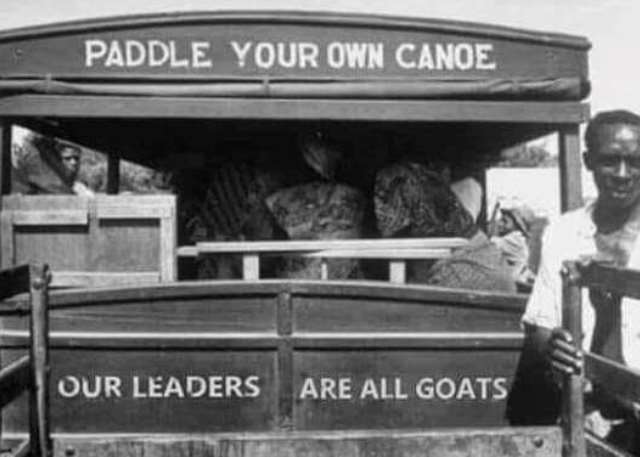
Photo: Modern Ghana
That said, many of the grounds for deeming Achebe’s work wise apply to Adichie’s as well—the complexity of its characterization, its attentiveness to social context, its foregrounding of ethical dilemmas, its privileging of social justice and reconciliation, and its focus on individuals in community (the clan for Achebe, the nation and family for Adichie).
Above all, Achebe and Adichie share a common respect for the dignity of all people. In her 2009 TED Talk, “The Danger of a Single Story,” Adichie recounts her first trip to Mexico and her surprise on discovering just how wrong the media sphere’s single story of Mexicans as “abject immigrant[s]” truly was. The single story, she recognizes, “makes our recognition of our equal humanity difficult.” “Stories can break the dignity of a people,” she concludes, “[b]ut stories can also repair that broken dignity” (“Danger”). Adichie’s reading of Okonkwo, the protagonist of Achebe’s Things Fall Apart, confers dignity on this otherwise rash and uncompromising character precisely by highlighting Okonkwo’s struggles “to understand a world in which the dignity he had always taken for granted has disappeared” (“Introduction” xi ff.).
Achebe published his account of the Biafran war of succession, There Was a Country, in 2012, some six years after Adichie’s Half of a Yellow Sun. Having briefly summarized the main drivers of the war and Achebe’s role in the war effort, Adichie’s review of the book turns lukewarm. There Was a Country, she writes, is “a book for Achebe’s admirers” alone because it “mostly foregoes personal memory” (“Things”). Adichie speaks of being left hungry for the small, personal details that make stories come alive, such as Achebe’s instinctive diving for cover on hearing a plane take off at London’s Heathrow airport: “I longed to hear more of what he had felt during those months of war—in other words, I longed for a more novelistic approach.” Trotting out the fellow writer’s nuclear option, she writes that, in Achebe’s book, “[t]here is more of what writing teachers call ‘telling’ and less ‘showing’.” Some years later, speaking of her research for Half of a Yellow Sun, Adichie would make a related distinction: “what I got from books were the facts, but from the stories people told me I got the truth” (Allardice). If Adichie is in many respects Achebe’s literary daughter, she remains (as Daria Tunca has nicely put it) an “unruly” one.
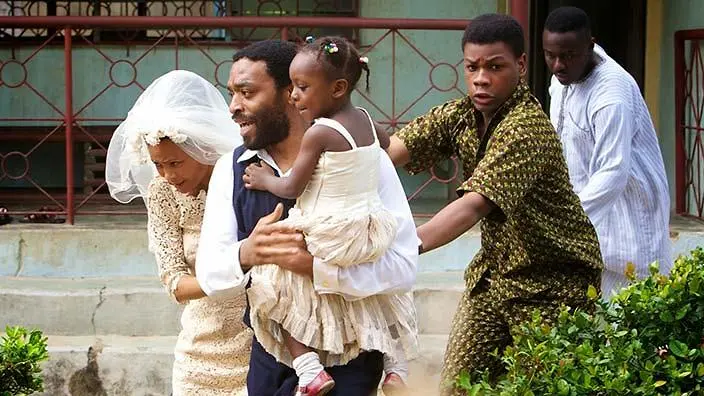
Photo: Half of a Yellow Sun, dir. Biyi Bandele
Half of a Yellow Sun tracks the lives before, during, and after the Biafran struggle for independence of five main characters: twin sisters Olanna and Kainene Ozobia, Olanna’s lover then husband Odenigbo, Kainene’s British ex-pat lover Richard Churchill, and Odenigbo’s houseboy Ugwu. Bouncing back and forth in time, the novel espouses the perspectives of three of these characters: Olanna, Richard, and Ugwu. We thus have a privileged perspective on Olanna’s struggles with her bourgeois parents, unfaithful lover, and resentful twin; on Richard’s abortive writing projects and search for belongingness in the new Biafra; and on Ugwu’s multistage journey from village houseboy to author.
The first and most obvious facet of Adichie’s “unruliness” with respect to her predecessor is in the area of gender. In her Introduction to The African Trilogy, Adichie notes that contemporary readers cannot help but be struck by Achebe’s tendency to equate “weakness and inability with femaleness,” before going on to find “some subtle ways”—very subtle, I would suggest—in which Achebe questions such patriarchy (xi). One can only wonder what Adichie made of the metaphorics of this passage from There Was a Country on Africa’s “great debt to female African intellectual forerunners”:
By boldly mixing numerous African and Western literary traditions in a cauldron, seasoning them with local color, and spicing their tales with the complexity of the human condition, modern women wordsmiths have deepened our understanding of the world. (112)
By contrast—from Purple Hibiscus’ Kambili Achike to Americanah’s Ifemelu, Olanna and Kainene very much included—Adichie’s richest, most complex characters are consistently women.
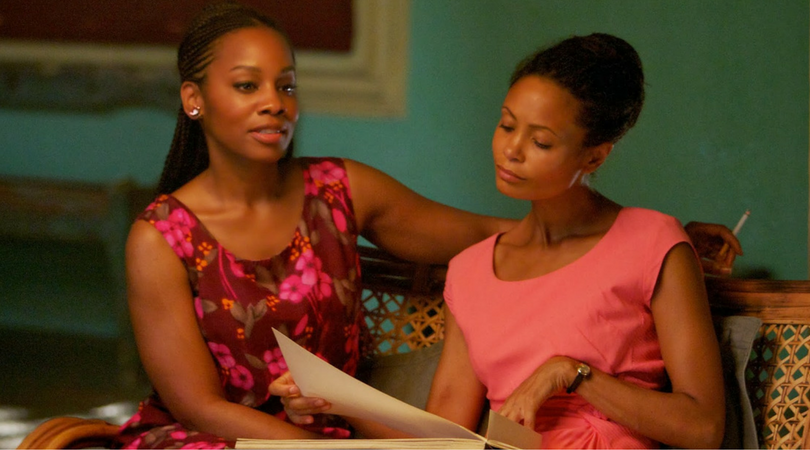
Photo: Half of a Yellow Sun, dir. Biyi Bandele
Although dryly sarcastic and often dismissive of her hyper-bourgeois parents, Kainene is nonetheless “determined to make her father’s factories grow, to do better than he had done” (97f.). It is a pleasure, as a reader, to watch Richard try (and often fail) to make sense of her, despite their mutual affection. Olanna clearly struggles with Odenigbo’s infidelity but ultimately decides to adopt the child it spawned, known as Baby, and throws herself into her work as a teacher in time of war. Tunca is precisely right in noting that, in Adichie’s novel, “love and the wider social and political context in which it occurs are inextricably intertwined” such that, “while the psychological struggles of Adichie’s characters are undeniably shaped by the politics of gender and nation, they also, and perhaps primarily so, illuminate the human condition” (112).
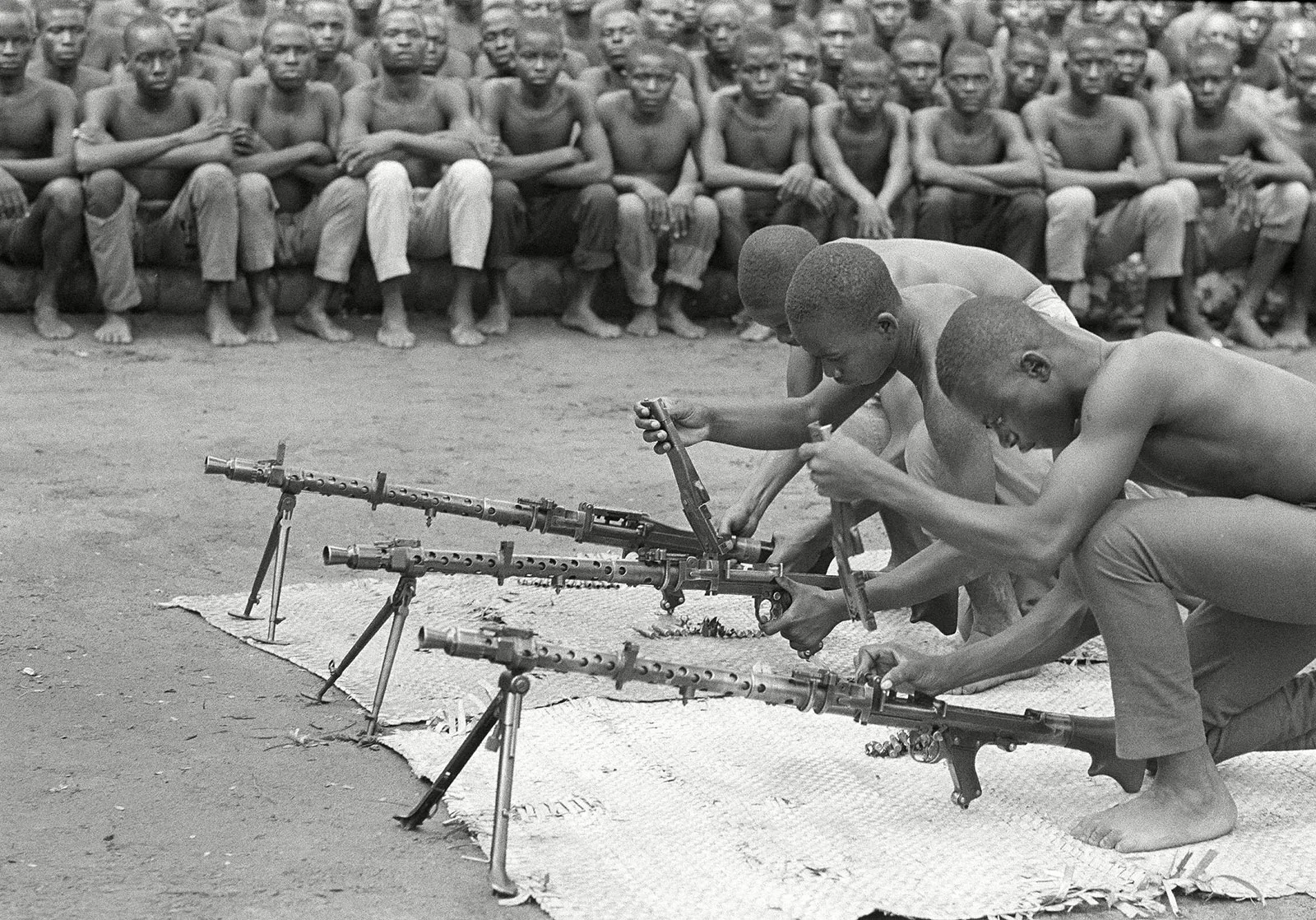
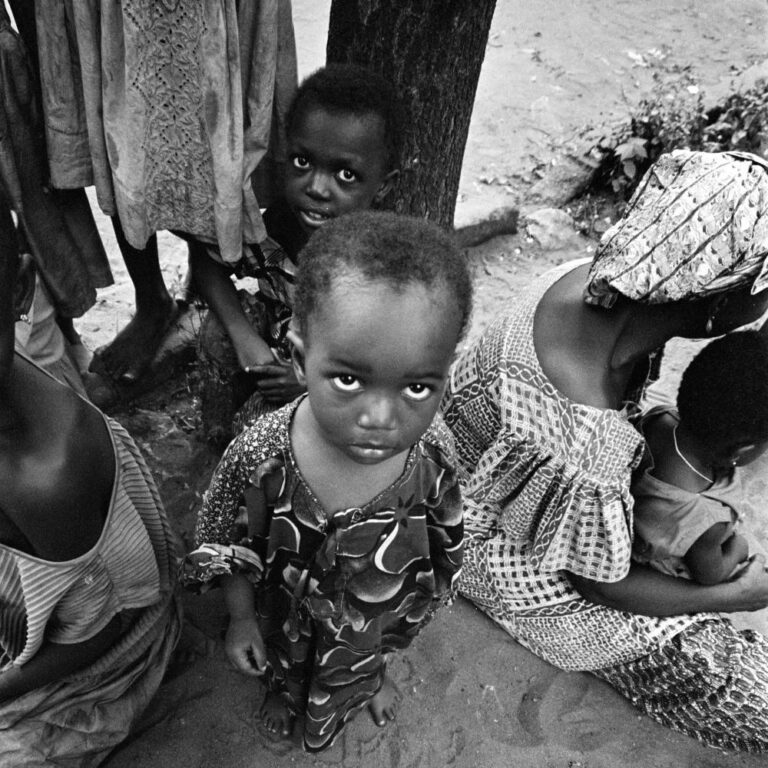
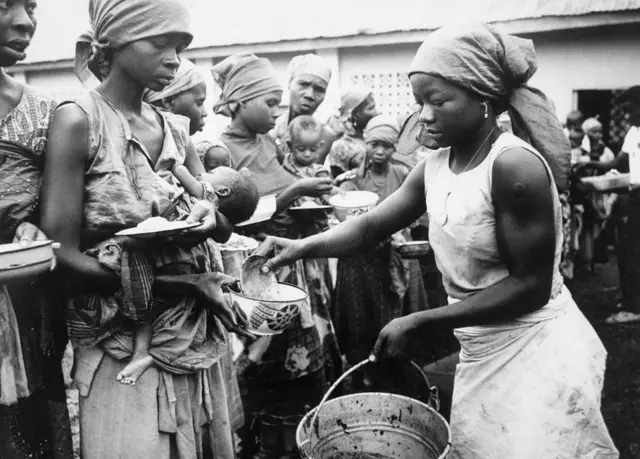
The second grounds for Adichie’s “unruliness” relative to her treatment of the Biafran war stem from her novelistic commitment to meticulously documenting the many facets of everyday life in wartime. Thus we read of the rape and death of loved ones, the struggles of Adichie’s characters in the face of forced displacement, their hiding from air raids and battles for food at relief centers, the peril of forced conscription and the “casual cruelty” of those conscripted, the appropriation of property and diversion of relief supplies, the proliferation of confused and contradictory rumors, the “madness of grief” (450, 481).
Photos: Brittanica, National Endowment for the Humanities, BBC
Adichie captures the trauma of civil war through a series of horrific, unforgettable scenes: the passport officer Nnaemeka’s death for refusing to say “Allahu Akbar” and his family’s decision to bury an empty coffin (192, 208); Ugwu’s finding, after an air raid, a discarded sandal and the body of a woman with her clothes burned off (255); Richard’s seeing a steward’s headless body continuing to run (398, 432); the man who “placed both hands on his blown-open belly as though to hold his intestines in” (458); Olanna’s breathing in “the thick ugly odors of unwashed bodies and rotting flesh” (489); her screams on learning of the poet Okeoma’s death and perception of being “attacked, relentlessly clobbered by loss” (491); the piles of dried feces left by Nigerian soldiers in Odenigbo and Olanna’s Nsukka bathtub (523). Especially poignant and resonant are the novel’s depictions of the war’s effects on children, whose memories and indeed lives are stolen by severe protein malnutrition (kwashiorkor). There is perhaps no scene that better encapsulates the horror of the war than that in which a woman on a train invites Olanna to peer into the bowl of a calabash containing her dead daughter’s head, saying “Do you know… it took me so long to plait this hair. She had such thick hair” (188). As an account of the Biafran war, in short, Half of a Yellow Sun is a masterpiece of “showing”.
In earlier posts, I discussed how the novel of formation or Bildungsroman has found its end in a pedagogy of wisdom—either for a protagonist (albeit often imperfectly) or for the reader. Half of a Yellow Sun’s moral center of gravity may be Olanna, but no character evinces a more pronounced developmental arc than the houseboy Ugwu. The novel opens with Ugwu newly arrived at Odenigbo’s Nsukka house, fascinated by the “magic” of running water and refrigeration and very much prone to adolescent sex fantasies (7). In short order, inspired by Odenigbo and Olanna, Ugwu becomes a lover of English, an avid reader of classics from Odenigbo’s library, and an often fanatical adopter of Western ways. When war breaks out, Olanna enlists Ugwu as a teacher of young children and attempts to shield him from forcible conscription in the Biafran army. But he is eventually conscripted and goes on to earn the sobriquet “Target Destroyer” for triggering a mine that kills a group of Nigerian soldiers. That very night, he reluctantly participates in the gang rape of a bar girl. Although reported dead in a catastrophic battle, Ugwu survives and makes his way back to Olanna, Odenigbo, and Baby, working at a refugee camp by day and writing by night, inspired in part by his recent discovery of Frederick Douglass’s autobiography.
With the exception of Kainene, all of the main characters in Half of a Yellow Sun commit transgressions. Odenigbo sleeps with Amala and possibly Alice. Richard and Olanna sleep with one another. But none of these transgressions approaches the severity of Ugwu’s participation in the gang rape, which leaves him haunted by the “dead hate” he saw in the eyes of its victim (497). When Richard tells Ugwu the title of a book he intends to write about the war, The World Was Silent When We Died, Ugwu is filled with shame: “It made him think about that girl in the bar, her pinched face and the hate in her eyes as she lay on her back on the dirty floor” (496). Shortly thereafter, he learns that his sister Anulika had herself been gang raped and nearly beaten to death. For Ugwu at least, the distinction between transgression and trauma that Mansfield et al. want to make is no distinction at all. The trauma of Biafran victimization at the hands of the Nigerian state is only compounded by the transformation of victims into the victimizers of their own people.
Adichie was born in 1977, some seven years after the fall of the Republic of Biafra. Yet the trauma of the war clearly marked her childhood, not least because it claimed both of her grandfathers (to whom Half is dedicated). As Marlene De La Cruz-Guzmán has argued, writing serves an act of “detraumatization” for both Ugwu and Adichie (62f.). Acknowledging that it would be impossible to accurately depict “the very bleakness of bombing people,” Ugwu comes to realize that “the more he wrote the less he dreamed” (498). And when Ugwu sets to writing out Olanna’s recollection of seeing the decapitated child’s head with its neatly plaited hair, Olanna feels that “his writing, the earnestness of his interest, suddenly made her story important, made it serve a larger purpose that even she was not sure of” (512).
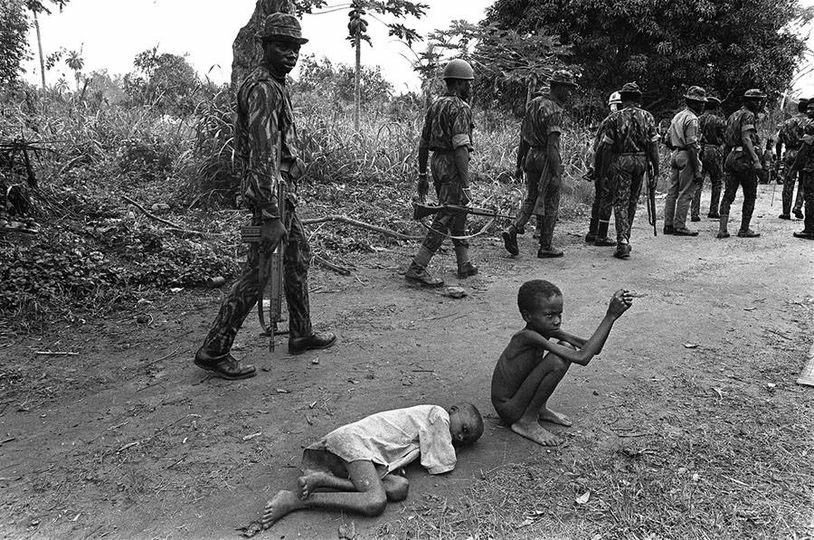
Photo: The Africa Report
Beginning at the end of Chapter Three, the first of several chapters told from Richard’s perspective, Adichie’s novel gives short summaries of material on the war under the heading: “The Book: The World Was Silent When We Died” (103f.). Subsequent summaries under that title include brief discussions of the birth of Nigeria and Britain’s assessment that the Muslim Hausa-Faluni people of the North were better suited to their policy of indirect rule (146f.); of Britain’s desire to “preserve Nigeria as it was… [as a] thorn in France’s eye” (195); of economic mismanagement in the wake of independence and how the 1966 massacres of Igbo peoples triggered the secession movement (256f.); of starvation as a “Nigerian weapon of war” and driver of world attention (296f.); and of how global fears of secession contagion generated support for Nigeria against Biafra (324). Five of these first six summaries fall at the end of Richard chapters, only one after an Ugwu chapter.
Early on, in the wake of the 1966 massacres, Richard writes a long article attributing the violence to the British colonizer’s “informal divide-and-rule policies” (210). But the article is rejected by an editor who longs for a more “human angle” and asks, ludicrously, “Did [the perpetrators] eat body parts like they did in the Congo?” (210). A version of The World Was Silent When We Died’s final title rings in Richard’s head as he begins writing for the Biafran Propaganda Directorate, a role that reminds him of Rimbaud’s phrase “I is someone else” (383, 386). Finally, the book’s definitive title comes to Richard after he escorts two American journalists around the war zone: “He would write it after the war, a narrative of Biafra’s difficult victory, an indictment of the world” (469). Kainene appropriately questions the “We” of “When We Died,” to which Richard responds: “I’ll make sure to note that the Nigerian bombs carefully avoided anybody with a British passport” (469). There follows a moving poem in the style of the poet Okeoma, entitled “Were You Silent When We Died?” and intended for the book’s epilogue. Addressed to readers looking at glossy images of starving Biafran children in the pages of Life magazine, the poem ends: “Their skin had turned the tawny of weak tea / And showed cobwebs of vein and brittle bone; / Naked children laughing, as if the man / Would not take photos and then leave, alone” (470).

Photo: Half of a Yellow Sun, dir. Biyi Bandele
In time, Richard comes to realize that Kainene’s skepticism about the use of “We” in his prospective title is well-founded and that there are limits to Rimbaldian self-displacement. After reading and admiring Ugwu’s description of Olanna’s encounter with the child’s head in the calabash—intended for a “big book” Ugwu is writing, Narrative of the Life of a Country—Richard tells Ugwu that “[t]he war isn’t my story to tell, really,” with which Ugwu tacitly agrees (530f.). The novel soon ends on this:
8. The Book: The World Was Silent When We Died
Ugwu writes his dedication last: For Master, my good man.
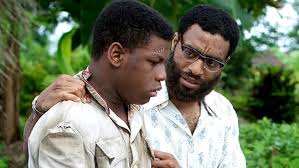
Photo: Half of a Yellow Sun, dir. Biyi Bandele
I would make three points about this ending. First and most obvious, Adichie has sprung a trap for us as readers, activating the colonialist association of writing and the power of historical narrative with the British colonizer as represented (albeit in complicated ways) by Richard, only to reappropriate writing and narrative power—not for the Nigerian elite, represented by Odenigbo, Olanna, and Kainene, but for a young houseboy up from his village. As I have argued in the case of both Imbolo Mbue’s Behold the Dreamers and several stories in Viet Thanh Nguyen’s The Refugees, this trap effectively fosters our humility as readers by activating, then giving the lie to, our profoundly faulty assumptions.
Writing of the novel’s ending, Ruth Wenske has argued that, whereas Adichie herself is “of the elite in the educated/uneducated class divide,” she “gives the underrepresented party [Ugwu, the former villager] the final voice in her novel” (84). True enough, except that—this would be my second point—Ugwu accedes to his voice by mimicking Odenigbo’s own mimicking of the British colonizer’s speech: “For Master, my good man.” Throughout her novel—as when she has Olanna’s former Muslim lover Mohammed say that “Allah will not forgive” the perpetrators of genocide at the compound of Olanna’s Uncle Mbaezi—Adichie works to complicate easy distinctions and show that societies and cultures are always works in progress, always subject to a complex web of appropriations and renegotiations, and rarely pure by whatever metric one might choose.
My final point about Adichie’s ending is more fanciful. With the arguable exception of the first, the initial seven summaries of material for The World Was Silent When We Died feel like the work of a historian or political scientist. Indeed, they anticipate many of the points that Achebe would make in the second part of There Was a Country, that part which Adichie found to be lacking the scenes and images from personal experience that make histories, and historical novels like Half of a Yellow Sun, come alive. Only with the calabash anecdote, and especially with the poem qua epilogue, does the anticipated material for Ugwu’s book attain the level of imagistic vigor that Adichie calls “novelistic” and that Ugwu himself fears that he will “never be able to capture” (498). Fully recognizing the chronological impossibility of this idea, I cannot help but read “For Master, my good man” as the last word of an unruly literary daughter fully cognizant of how her novel, with its stunning images and profound depiction of the traumas of everyday life in community during a genocidal war, represents a step beyond her Master’s work.
