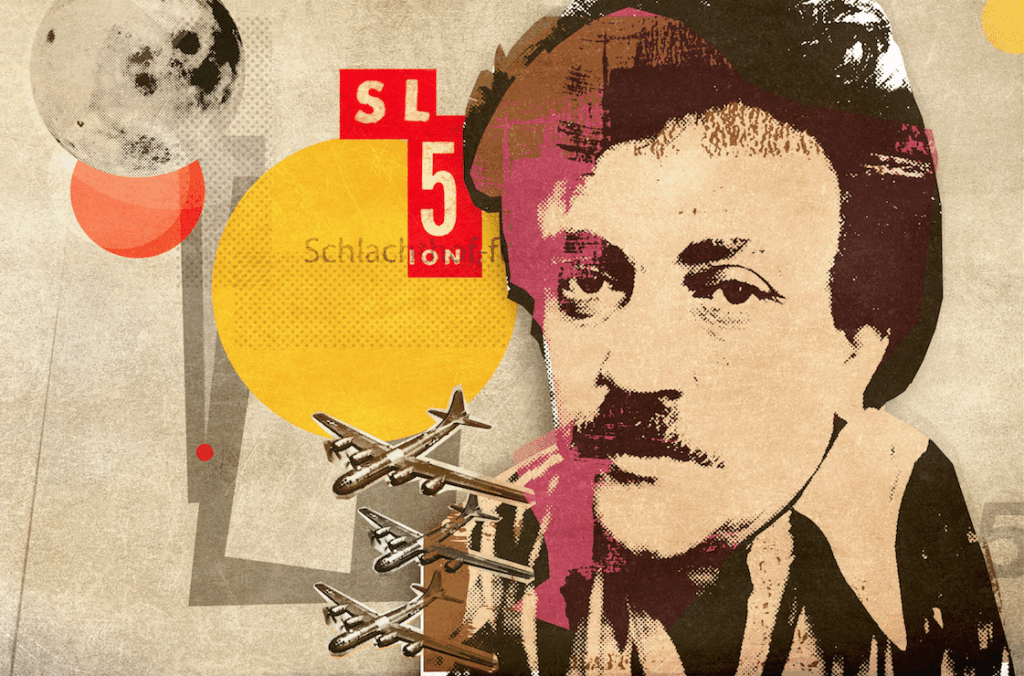
Photo: Peter Horvath
In Vonnegut, that which survives being proofed by satire, as Billy Pilgrim is so mercilessly in Slaughterhouse Five, becomes both human and wise.
Like many adolescents of my generation, I devoured the novels of Kurt Vonnegut in the late 60s and early 70s. They felt fresh, massively irreverent, and—at the height of the war in Vietnam—appropriately skeptical of the powers-that-be and their tendency to ship mere children off to battle.
Rereading Slaughterhouse Five some fifty years on has been an object lesson in how readers’ perceptions can change over time. Passages that used to feel bawdy and irreverent now feel cringeworthy or worse. Still more so than in the past, we are repeatedly forced to ask ourselves: is Vonnegut’s recourse to objectionable images and stereotypes an example of free indirect discourse, and thus ultimately satirical in nature, or is it a reflection of deep-seated authorial bias?
For reasons I will return to later, I am reasonably comfortable attributing satirical intent to the novel’s speaking of the inhabitants of Sodom and Gomorrah as “vile people” without whom “the world is better off” or of Jesus as the “wrong guy to lynch” (27, 139). Harder to attribute to satire, because more insistent, is the novel’s recourse to misogynist language, as when its protagonist, Billy Pilgrim, speaks of his daughter as a “bitchy flibbertigibbet” with “legs like an Edwardian grand piano” or the narrator characterizes a guest at Billy’s anniversary party as “a dull person, but a sensational invitation to make babies” (36f., 218). The misogyny of late 60s counterculture, after all, was a major catalyst in the spread of second-wave feminism just a few years later.
The Serenity Prayer appears twice in Slaughterhouse Five: first, in a framed print on Billy’s office wall; second, in the drawing of a locket worn by Billy’s companion and lover on the planet Tralfamadore, the former porn star Montana Wildhack (77, 266). Both appearances implicitly reference the kitschification of Niebuhr’s prayer in the 1960s. The drawing, with its cartoonish display of a prayer-inscribed locket nestled into Montana Wildhack’s ample bare breasts, further evokes the specter of misogyny.
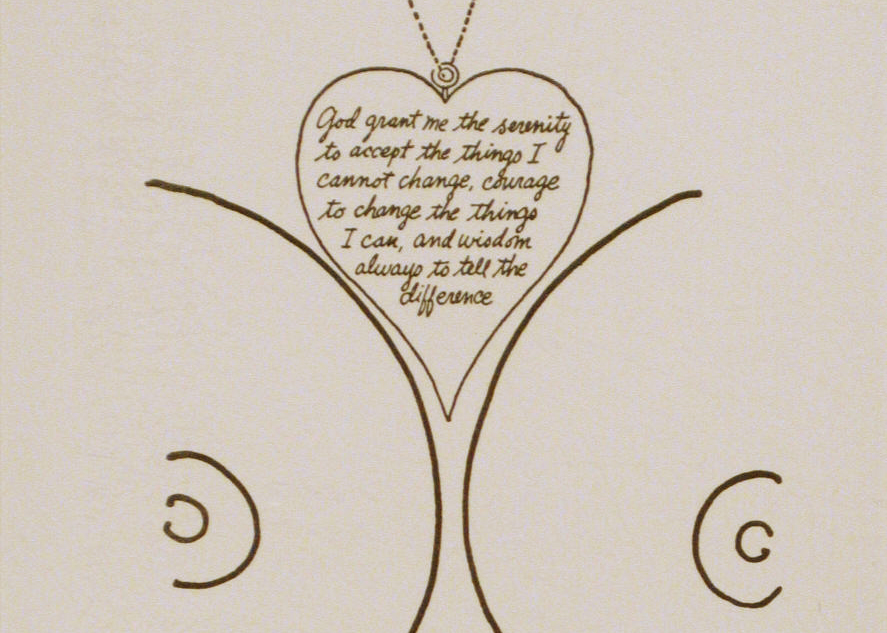
Photo: Kurt Vonnegut
Beyond the question of satire, the centrality of the Serenity Prayer in Slaughterhouse Five is ironic in two respects. In the book’s opening chapter, Vonnegut frames his account of Billy Pilgrim’s wartime experiences with an extended discussion of the Children’s Crusade of 1213. In so doing, he both elucidates the book’s full title—Slaughterhouse Five, or The Children’s Crusade, a Duty-Dance with Death—and reinforces the argument of a friend’s wife that wars are invariably fought by babies pretending to be men (18ff.). Indeed, it is hard to reconcile the call for God’s grace with which the Serenity Prayer typically begins with the novel’s insistent questioning of “why Christians found it so easy to be cruel” (138). In this respect, Slaughterhouse Five recalls Niebuhr’s critique of the un-Christlike behavior of certain supposed Christians, most notably those in the Ku Klux Klan.
The second irony that attends the Serenity Prayer leads us into two of the novel’s central paradoxes. The story of Billy Pilgrim—Vonnegut’s protagonist and partial doppelgänger—opens like this: “Listen: / Billy Pilgrim has come unstuck in time” (29). Beginning in 1944, in the throes of World War Two, Billy becomes subject to random, “spastic” jumps in time, between moments of personal history linked only by tenuous associative threads (29). When he is subsequently kidnapped by inhabitants of the planet Tralfamadore, his captors explain (as he later recounts): “All moments, past, present, and future, always have existed, always will exist…. It is just an illusion we have here on Earth that one moment follows another one” (34). Because temporal sequence is but an illusion, the very concept of causality becomes null and void: “[t]here is no why” and “[o]nly on Earth is there any talk of free will” (97, 109).
What are we to make, then, of a novel that gives pride of place to a prayer that asks for the “courage to change the things I can,” which presupposes both causality and free will, but that also speaks of past, present, and future as eternally pre-ordained and likens human subjects to “bugs… trapped in the amber of this moment” (97)? Is the only way out of this paradox to accede to the arguments of those who contend that the Serenity Prayer is ultimately a recipe for quietism—especially in a novel that meets every report of death, human and otherwise, with the Tralfamadorian expression, “So it goes” (34)? After all, despite his having seen at Dresden—like Vonnegut himself—the “hideous things” that saturation bombing can do, Billy is “not moved to protest the bombing of North Vietnam” (76).
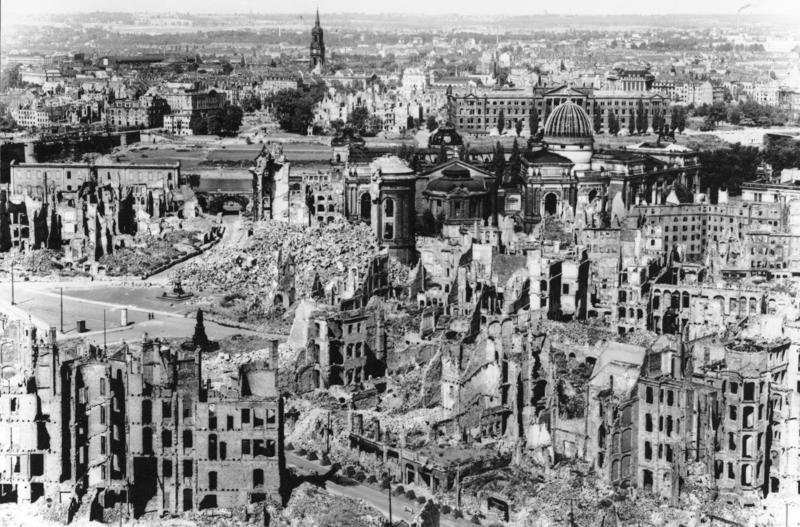
Photo: Bundesarchiv
This leads us to a second, related paradox. In an earlier post, I quoted Don DeLillo’s Libra to the effect that there is “a tendency of plots to move toward death…. the idea of death is woven into the very nature of every plot” (221). In Slaughterhouse’s first chapter, the author-narrator references French novelist Louis-Ferdinand Céline in claiming that “[n]o art is possible without a dance with death,” which for Billy is curiously anticlimactic: “just violet light—and a hum” (27, 55).
The discrepancy between these two, apparently similar positions is telling. In the opening pages of Slaughterhouse, Vonnegut speaks of himself as a “trafficker in climaxes and thrills and characterization and wonderful dialogue and suspense and confrontations” (6). This is clearly ironic. The novel does everything in its power to avoid the thrill of traditional plots—not just because its protagonist becomes “unstuck in time,” but also by announcing the beginning and end of Billy Pilgrim’s story right up front:
This [war book] is a failure, and had to be, since it was written by a pillar of salt. It begins like this: / Listen: / Billy Pilgrim has come unstuck in time. / It ends like this: / Poo-tee-weet? (28)
In Slaughterhouse, the deathward logic of plot gives way to a final scene at the war’s end in which literally nothing is going on save for a random bird call, because “[e]verything is supposed to be very quiet after a massacre… except for the birds” (24).
When we first encounter the Serenity Prayer in a frame on Billy’s office wall, we are told that it “expressed his method for keeping going, even though he was unenthusiastic about living. A lot of patients who saw the prayer on Billy’s wall told him it helped them to keep going, too” (76f.). Given that Billy Pilgrim’s surname is almost certainly a play on the title of John Bunyan’s 1678 theological narrative, The Pilgrim’s Progress, we can reformulate our questions around the Serenity Prayer as follows. What is it about the prayer that helps a protagonist whose very name evokes a conception of progress keep going in a novel that denies the possibility of progress through courageous action while undermining its very status as a traditionally plotted narrative? And if Slaughterhouse effectively forecloses courageous action in the world and the wisdom that helps foster it, is there then no place for wisdom in it?
I see three ways in which Slaughterhouse’s antinovelistic “dance with death” makes a place for a certain form of wisdom—all growing out of the novelist’s and protagonist’s traumatic experience in the bombing and subsequent firestorm at Dresden.
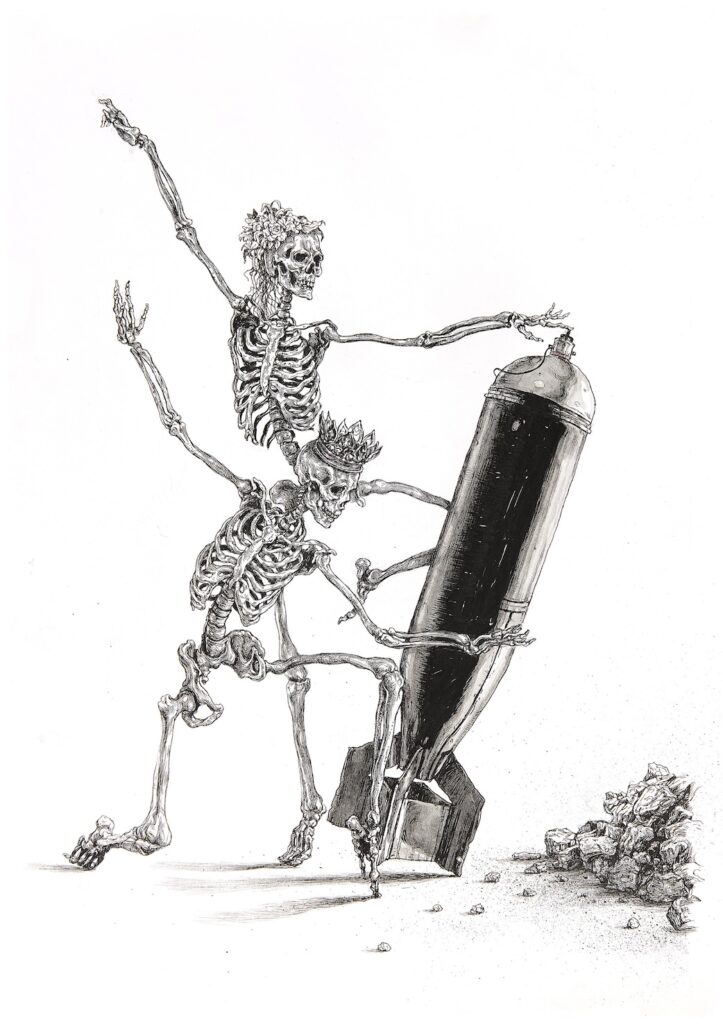
Photo: Vincent Valdez
First, the novel clearly valorizes the experience of those, be they fictional or not, who have lived through (and subsequently struggled with) the Dresden massacre. And it does so in opposition to those, such as the entitled and insufferably virile official Air Force historian with whom Billy comes to share a hospital room, who “were too remote from the harsh realities of war to understand fully the appalling destructive power of air bombardment in the spring of 1945” (241). “I have told my sons,” the author-narrator writes, “that they are not under any circumstances to take part in massacres, and that the news of massacres is not to fill them with satisfaction or glee” (24).
Second, the novel evinces a consistent and clear-cut sympathy for the powerless, even if Billy sometimes ignores them. The narrator’s protestations notwithstanding, it is hard to read the scene in which Billy, now unexpectedly rich, is “pulled apart inside” by the song of a post-war barbershop quartet as solely an echo of his experience with four guards in the slaughterhouse meat locker where he took refuge during the bombardment and not also of a song that asks “[h]ow in the world can a poor man eat?… The load’s too heavy for our poor backs” (224). Indeed, in There Was a Country, Chinua Achebe reports that Vonnegut “was so devastated following his trip [to the war-wracked and desperately impoverished Biafra] that he cried for weeks” (105).
In one of the novel’s most daring paradoxes, moreover, Vonnegut places a trenchant critique of the ways in which American culture invites the American poor to blame themselves for their poverty—“This inward blame has been a treasure for the rich and powerful”—in the mouth of an otherwise cartoonish American Nazi (165). Finally, the problem with Jesus in Slaughterhouse Five is that he was too “well connected” (138).
Third and most telling, we have this short passage that immediately follows the narrator’s description of the inhabitants of Sodom and Gomorrah as “vile people” and precedes his description of his novel as a failure “since it was written by a pillar of salt”:
And Lot’s wife, of course, was told not to look back where all those people and their homes had been. But she did look back, and I love her for that, because it was so human. / So she was turned into a pillar of salt. So it goes. (28)

Photo: Dead Sea
More than any other, I find this to be the passage where Vonnegut reveals where his tonally slippery novel ultimately stands. In the face of immeasurable horrors, humanity and wisdom reside in the longing look backwards—by Lot’s wife, but also by the author as himself a “pillar of salt”—at the destruction wrought by “brimstone and fire” (27). However problematic Vonnegut’s tone remains to modern ears, there is no escaping the novel’s fundamentally humanistic wisdom—the province of those “without power” who, like Billy, are “trying to prove to a willfully deaf and blind enemy that [they are] interesting to hear and see” (247). To borrow a turn of phrase from Jonathan Culler’s description of Flaubert’s irony: in Vonnegut, that which survives being proofed by satire, as Billy himself is so mercilessly in Slaughterhouse, becomes both human and wise.
