Portions of this post first appeared in Inside Higher Ed and are reprinted here with permission

Photo: Love Books Review
Cultivating intellectual humility initiates a virtuous circle, the result of which is a greater capacity for wisdom in all its dimensions.
We tend to think of wisdom as a state or characteristic that some of us have and others do not. As I have suggested throughout, it is far better to think of it as a process unfolding in time. Rare is the individual who is consistently wise or consistently unwise. Most of us experience advances in wisdom, followed by inevitable setbacks, and at any one time are wise in some respects and unwise in others. My colleagues often commended my ability as an academic administrator to dispassionately adjudicate in situations of professional conflict. As my family will attest, however, emotional regulation goes out the window when you put me behind the wheel.
As a process, wisdom is typically worked out in dialogue, not only with others but also with ourselves. Whatever quarrels we might have with Plato’s philosophy—be they around his aversion to poets or (more seriously) his antidemocratic bias—Plato’s work gave us the Socratic dialogue, the cornerstone of what has historically been called liberal education. Interestingly, there is evidence that wisdom can be improved in the absence of actual interlocutors. In a study of the role that “interactive minds” play in facilitating demonstrations of wisdom, Ursula Staudinger and Paul Baltes note that the interaction of test subjects
with the mental representation of other persons’ knowledge (internal or ‘virtual’ dialogue) was as powerful a facilitator of wisdom-related performance as was actual social interaction with another person when subsequent individual thinking time was provided. (758)
For those of us who are privileged to spend our careers in classrooms, teaching is clearly the most essential wisdom dialogue.
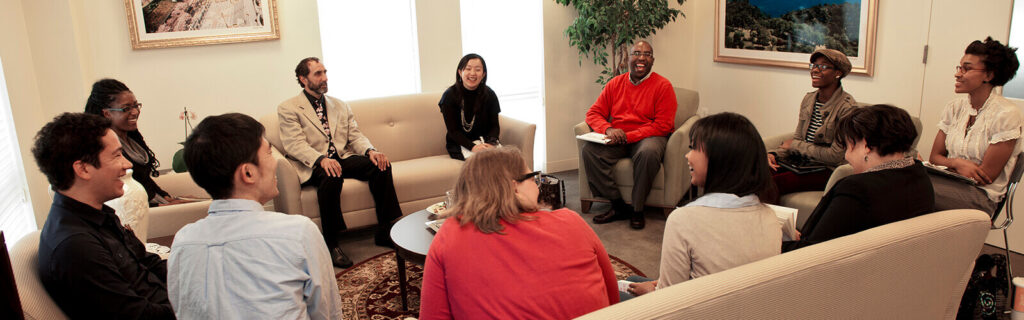
Photo: American Philosophical Practitioners Association
As any good teacher will tell you, cultivating wisdom in others or in ourselves is hard work, demanding as it does that we resist the temptation to fall back into disciplinary jargon or to settle for having students parrot our analyses back to us. Wisdom-forward pedagogy requires that we remain as open to the acquisition of greater wisdom as we ask our students to be. To borrow a turn of phrase from Adam Gopnik, wisdom “is an effort, not an end point” (27).
In an important article from 2020 by an international group of wisdom researchers known as the Wisdom Task Force, Igor Grossman and colleagues speak to an ongoing skepticism around the “trainability of central wisdom characteristics” (118). Although “theorizing on teaching for wisdom is abundant,” they note, “the effectiveness of teaching-based interventions for growth in moral aspirations or PMC [perspectival aspects of metacognition] has not been confirmed empirically” (118). As Grossman and his colleagues well know, however, most empirical studies of wisdom acquisition take place within relatively short time frames. As a result, they can fail to capture the cumulative effect of multiple wisdom-based interventions. Indeed, one of the lessons of Tuesdays with Morrie was just how long it took Mitch (as Morrie’s past and present student) to absorb what Morrie had to teach him. I would contend that multiyear time lags—over 15 years in Mitch’s case—are as much the rule as the exception.
At a time when our media environment and our practices of secondary education tend to reward those who stake out a position and defend it at all costs, it is vital that we as educators teach our students to acknowledge and appreciate complexity, in both its cognitive and ethical forms. This means helping them to question the easy (but typically false) solutions and Manichaean dualisms so rampant in contemporary public discourse and to grow comfortable with situational complexity, uncertainty, ambiguity, ambivalence, irony, paradox, and contradiction. Focusing our pedagogy on the quarrel between valid interpretative approaches to a given question or problem is a key strategy in this respect. But no strategy is more vital in helping students to cultivate their wisdom than working through the moral dilemmas that arise when deeply engrained cultural and ethical values come into conflict.

Photo: Institute for Digital Transformation
Wisdom researchers often test their subjects’ wisdom by asking them to respond to short case studies that pit conflicting values against one another. It is my contention that novelistic narrative is superior to the case study in its ability to explore value conflicts both deeply and as they evolve over time. Many of the texts I analyze here do so, perhaps none more so than Achebe’s Arrow of God and Le Guin’s The Left Hand of Darkness.
Our students’ ability to understand (and ultimately adjudicate among) conflicting cultural norms depends on their seeing how the actions and values of individuals—be they historic, contemporary or fictional—have been shaped by their particular social, cultural, economic, and religious contexts. Studying abroad in a culture radically different from one’s own has long been understood to be an outstanding way to solidify this awareness, consistent with Mark Twain’s insight that travel is “fatal to prejudice, bigotry, and narrow-mindedness…. Broad, wholesome, charitable views of men and things cannot be acquired by vegetating in one little corner of the earth all one’s lifetime” (650). But study abroad is most conducive to such cross-cultural sensitivity if students have been prepared to develop that sensitivity through experiences and coursework prior to, and contemporaneous with, their overseas experience. With their unparalleled sensitivity to how the rituals of everyday life inform the reaction to cultural stresses in Japan and several African countries, Ruth Ozeki’s A Tale for the Time Being, Chris Marker’s Sans soleil, and Chimamanda Ngozi Adichie’s Half of a Yellow Sun are exemplary in this respect.

Photo: TESOL Career Center
Of course, one need not leave the U.S. to experience cultures dramatically different from one’s own. For many of us, Louise Erdrich’s The Night Watchman and Toni Morrison’s Beloved provide deep exposure to cultural norms, values, and (yes) traumas that we have not experienced directly. Regardless of cultural location, building student awareness of how the context of diverse cultures informs those cultures’ values, and ultimately their wisdom, is a critical step in helping our students along their wisdom paths. It may also be opportunistically savvy, given Joseph Aoun’s suggestion in Robot-Proof that fostering student engagement with diverse cultures is doubly valuable in the age of artificial intelligence insofar as cultural context is “not easily appreciated by even the most intelligent of machines” (73).
Thinking of the ways in which novels effectively put the reader into the head of their characters, and buttressed by David Kidd and Emanuele Costano’s contention that the act of reading of literary fiction boosts empathy and emotional intelligence, Gary Saul Morson and Morton Schapiro suggest that, “[e]ndlessly repeated, this experience of another person from within teaches us empathy by making it a habit” (230). As I have argued here, one need not go back to the great works of the nineteenth-century psychological realists—Tolstoy, Eliot, Austen, et al.—to find novels that do this. Imbolo Mbue’s Behold the Dreamers, Toni Morrison’s Beloved, Ruth Ozeki’s A Tale for the Time Being, Ian McEwan’s Atonement, and Ursula Le Guin’s The Left Hand of Darkness all foreground the experience of empathetic ‘reading’—either within the novel, between the novel and the actual reader, or both.
Aristotle’s dictum that “it is impossible to be practically wise without being good” points to a fourth way to teach for wisdom—by fostering in our students a sense of social justice and a deep-seated respect for the common good (1144a). In an age that tends to lionize individual achievement, real or illusory, and that glorifies nations in ways that mirror rabid individualism’s exclusionary tendencies, it is all the more critical to understand the common good in the broadest possible sense. In their own ways, Chinua Achebe’s Arrow of God, Chimamanda Ngozi Adichie’s Half of a Yellow Sun, Toni Morrison’s Beloved, and Alison Bechdel’s Dykes to Watch Out For all thematize the difficulties of maintaining communities under external pressure and militate for expanding our conception of the common good.

Photo: Francesco Cicolella
Finally, and in many ways most critically, wisdom implies intellectual humility, the capacity (to paraphrase Socrates) not to think that we know what we in fact do not. Intellectual humility is not something that comes naturally to the talented eighteen- to twenty-two-year-olds who populate our undergraduate classes, or that we ourselves once were. And nothing is more counterproductive, nor more hostile to learning as a process of mutual discovery, than simply insisting upon our students’ ignorance. In all of its manifestations, wisdom is not an end state so much as a process. Although wisdom is of necessity built upon a foundation of knowledge and expertise, it is not a body of knowledge per se so much as an approach to its acquisition. Wisdom is not a fixed corpus of moral and ethical answers, but a deep-seated (and ever-renewed) engagement in ethical questioning.
In an important sense, intellectual humility is both a precondition to, and the result of, the prior four markers of wisdom. Understanding that our judgment is far from infallible and that there is always more to learn leaves us open to situational complexities, ambiguities, and uncertainties; to the experience of radically different cultural contexts; to empathy for others; and to concern for the common good. Cultivating intellectual humility—in our students and in ourselves—thus initiates a virtuous circle, the result of which is a greater capacity for wisdom in all its dimensions.
Students—and indeed we as faculty—have much to learn from the now extensive body of philosophical and psychological literature on wisdom. But the most essential step that we as professors can take in teaching for wisdom is to model intellectual humility, to allow all that we do not yet know, and may never know, to shine through our disciplinary expertise, to let our continued curiosity about the world we live in trigger our students’ enthusiasm to acquire knowledge and to use it in the wisest possible ways.
