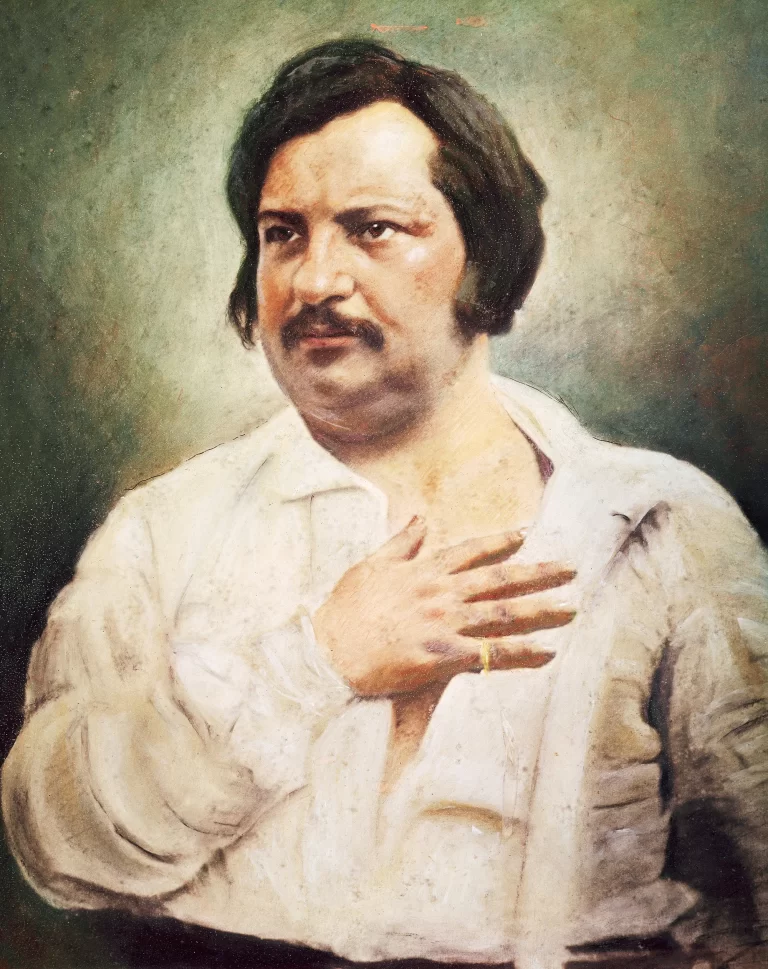
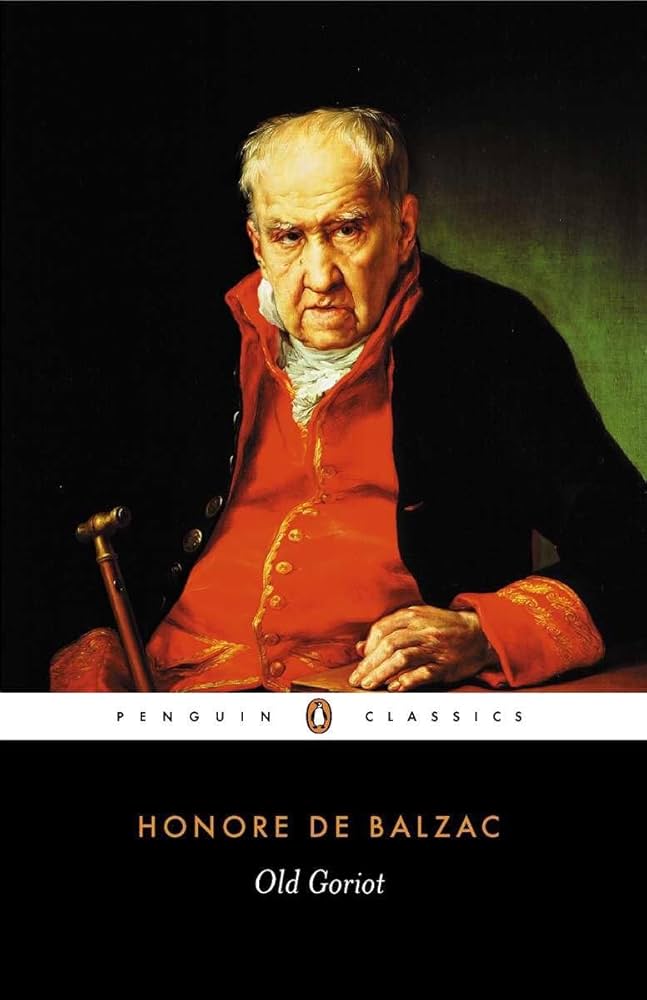
Photos: The New Yorker, Penguin Books
Rastignac gives up on his chance for wisdom, but Balzac clearly holds out hope, against considerable odds, for his implied reader.
I have suggested that Lin-Manuel Miranda’s Hamilton derives much of its power from its creative reworking of the traditional Bildungsroman. Generally dated from the publication of Goethe’s Wilhelm Meister’s Apprenticeship (1795-6), the so-called novel of formation models a young person’s process of maturation as they come to understand and struggle against the world they live in while accumulating the knowledge and experience that are the necessary (but not sufficient) foundations of wisdom.. Often beginning with the journey to a big city that triggers an experiential reframing, the Bildungsroman tracks its protagonist’s capacity to learn from adversity and failure so as to achieve personal growth and social success.
Many early novels of formation, Old Goriot very much among them, can be read as ‘how to’ manuals, primers for young, often provincial men and women (though typically men) seeking to make their way in Paris, London, or Berlin. At their best, however, these novels also functioned, and still do, as schools for a certain wisdom. Much of their power derives from their ability, intrinsic to the novel form as such, to convey detailed knowledge of what a variety of characters might be thinking and feeling in complex social situations. To the extent that they explicitly foreground their characters’ need to balance self-interest, the interests of others, and the interest of society as a whole, these novels also enact the conundrums that Robert Sternberg suggests are ideal for the assessment of wisdom—namely, “complex conflict-resolution problems involving the formation of judgments, given multiple competing interests and no clear resolution of how these interests can be reconciled” (“Balance” 355, 360).
The advantage of the novel form for wisdom lies not just in its representation of competing interests (intrapersonal, interpersonal, and social), but also of how those interests unfold over time. Proverbs may represent social wisdom and interests in their most condensed form. But until they are integrated into the unfolding of narrative, as the novels of Chinua Achebe’s African Trilogy do to brilliant effect, they miss a dimension of wisdom that Baltes and Staudinger call “lifespan contextualization,” a sense for how an individual and the many life contexts that shape her develop over time (126).
Among the many other stories it tells, War and Peace charts Count Pierre Bezukov’s quest for meaning and self-fulfillment “in philanthropy, in Freemasonry, in the distractions of social life, in wine, in a heroic deed of self-sacrifice, [and] in romantic love” (1012). But only after Pierre has experienced the horror of the Battle of Borodino, been taken prisoner by the French, and come to see his fellow prisoner Platon Karataev as “the unfathomable, round and eternal embodiment of the spirit of simplicity and truth” (974) does he find what he has been looking for:
And, without thinking, he had received that peace and harmony with himself only through the horror of death, through privation, and through what he understood in Karataev. (1012)

Photo: War and Peace, BBC, dir. Tom Harper
Without his various false starts, and without having seen scores of soldiers cut down in the prime of their lives, Tolstoy suggests, Pierre would not have experienced spiritual rebirth in the simple act of eating potatoes with a peasant compatriot. Or as Andrew Kauffman writes: “His realization in captivity is so compelling to him—and thus to the reader—in direct proportion to how long he has had to fight to achieve it” (192).
Balzac’s Old Goriot tells the story of Eugène de Rastignac, scion of an impoverished noble family from the Charente who goes up to Paris to study law. Shortly after his arrival, Rastignac realizes that his true goal is to “map the windings of the Parisian labyrinth [and] become a citizen of the capital with a knowledge of itsusages, its language and its particular pleasures,” so as ultimately to ensure his and his family’s otherwise uncertain futures (55f.).
Rastignac is the quintessential realist protagonist to the extent that he is endowed with an “observant curiosity” and can move freely between two very distinct worlds (35). On the one hand, he introduces us to the Maison Vauquer, the boarding house where he resides amidst a motley crew of students, bureaucrats, impoverished women, retirees, and a criminal in hiding. Balzac’s description of the “middle-class boarding house” is a set piece—arguably, the set piece—of French realist description (32). Beginning with the house’s exterior, with its “happy family of pigs, hens, and rabbits,” the narrator takes us into its interior with its “boarding-house smell” and “old, cracked, decaying, shaky, worm-eaten, decrepit, rickety, ramshackle” furniture (30-32). The description ends with a portrait of the proprietress, Madame Vauquer, a 50-something widow with the “glassy eye and innocent air of a procuress” who “resembles all women who have had a peck of troubles” and whose “whole person… provides a clue to the boarding-house, just as the boarding-house implies the existence of such a person as she is” (33). With its recourse to ostensibly shared stereotypes—e.g., the boarding-house smell and women with a peck of troubles—and its insistence that characters are the product of their milieu and vice versa, Balzacian description invites the (ostensibly naïve) reader to take full possession of the world it describes.
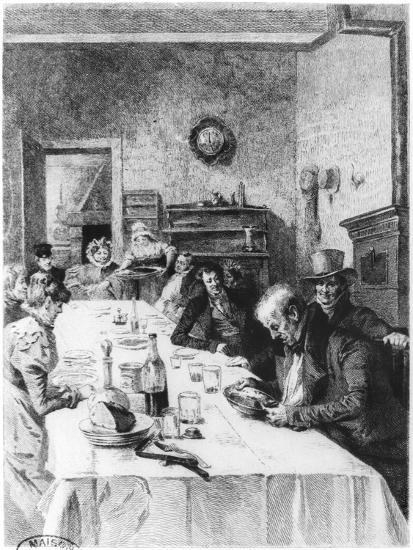
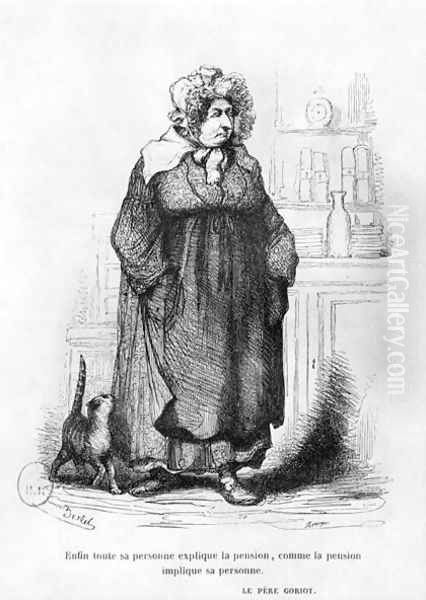
Photos: Albert Lynch, Albert Arnoux Bertall
On the other hand, Rastignac introduces us to gilded Paris, to which he enjoys right of admission thanks to his cousin, Madame la Vicomtesse de Beauséant. After Rastignac commits an initial faux pas, Madame de Beauséant takes him under her wing, teaching him how to succeed in Parisian high society. She tells him never to present himself at a great house without knowing all there is to know about the family, to always calculate the effect of his words, and to hide any real feeling “like a treasure” (92, 95, 103). In Paris, she counsels: “you will be no one… unless you have a woman to interest herself in you…. [S]ocial success is everything, it is the key of power” (103f.). Above all, she urges Rastignac to
sound the depths of feminine corruption, and measure the immensity of the miserable vanity of men…. The more cold-bloodedly you calculate, the farther you will go. Strike ruthlessly and you will be feared. (103)
Throughout the novel, Eugène tends to associate Madame de Beauséant, whose very name suggests a beautiful seemliness, with “the pure and holy influence of family affection” (100). At novel’s end, as she hosts a ball to which all of high-society Paris flocks to witness her abandonment by her lover, Madame de Beauséant calls Rastignac “kind and noble, unspoiled and open-hearted,” while he comes to appreciate her “suffering borne with fortitude” (275f.). In short, she sees in Rastignac, and herself represents, a form of nobility that will soon no longer exist thanks to profound changes in the socio-economic hierarchy of France in the decades after the Revolution.
But Madame de Beauséant is not the only character seeking to mentor Rastignac to social success. He is also counseled by Vautrin, an escaped convict in disguise variously known by his given name, Jacques Collin, and his nickname, Cheat Death. Recognizing that Rastignac has opted for “success at any price,” Vautrin advises him to abandon his legal ambitions (such as they are) and to seek his fortune in a “wife’s dowry” (128). In Paris, Vautrin says: “honesty is of no avail”; one only succeeds “by the brilliance of genius or the cunning use of corruption”; and “if you want to make a fortune quickly, you must already be rich or appear to be so” (129f.). To live well in Paris, he adds, “you have to dirty your hands…. The only thing that matters is how to get them clean again; in that art lies the whole morality of our times” (130).
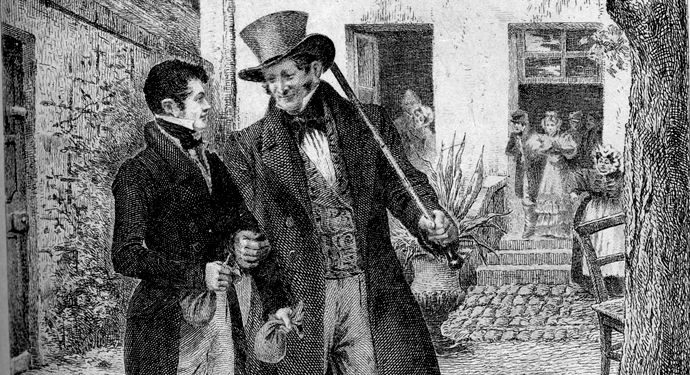
Photo: The Conservative
Reflecting on the precepts offered by Madame de Beauséant and Vautrin, Rastignac recognizes that the latter “only told me bluntly what Mme. de Beauséant dressed up in polished phrases” (136). Nonetheless, the two characters represent distinct poles—nobility and family feeling on the one hand, criminality and revolt on the other—between which Rastignac vacillates as the novel charts the uneven development of his “good qualities and weaknesses” (121). Immediately after recognizing the kinship between Madame de Beauséant’s and Vautrin’s advice, for example, Rastignac vows to “work honorably and uprightly,” only to be “transformed completely” in the very next paragraph when he puts on the new morning clothes that he purchased with money he “bled” (Vautrin’s word) from his sisters (137, 129).
In furtherance of his dream to “live like a monarch” as a plantation owner and slaveholder in the American South, Vautrin works to engineer a marriage between Rastignac and a fellow inhabitant of the Maison Vauquer, Victorine Taillefer, whom he will make immensely rich by killing off (in a duel he orchestrates) her favored brother. The duel takes place and the brother is killed, but Rastignac is spared having to follow through on a plot he never fully countenanced by the capture and unmasking of Vautrin by the police. The scene in which Vautrin is revealed as Jacques Collin—a “poet of Hell” and “fallen archangel whose only wish was for eternal enmity”—is over the top, even by Balzac’s standards, but it confirms Rastignac’s ethical vacillations. Although concluding that Vautrin’s unmasking reveals that “the path pointed out to him by delicacy and his better impulses was the right one” (232), Rastignac in fact knows better. For as the unmasked Jacques Collin rails against a “rotting society,” Rastignac “lowered his eyes, acknowledging, in expiation of his secret evil thoughts, the kinship with him that the criminal claimed” (221).
No less important in the unfolding of Rastignac’s ambitions and moral life is the novel’s title character, a retired vermicelli merchant known to his fellow pensioners as Old Goriot. Although Goriot made his fortune selling flour for ten times its cost during the Revolution, thereby confirming Vautrin’s maxim that the “secret of great fortunes with no apparent source is a forgotten crime,” Goriot himself falls squarely on the nobility side of Rastignac’s moral equation (136). A modern day King Lear, Goriot has devoted nearly his entire fortune to his beloved daughters—the Countess Anastasie de Restaud and Delphine de Nucingen—who, egged on by their embarrassed husbands, treat him miserably. Rastignac’s “growing secret friendliness” with Goriot results in Goriot’s funding an apartment for Rastignac’s trysts with Delphine, but also in Rastignac’s coming to see Goriot and his paternal love as “sublime” (138, 102). Goriot dies at the moment he is drained dry, attended only by Rastignac and the medical student Bianchon. On his deathbed, he admits that he has loved his daughters “too much” and “taught them to trample me underfoot” (284, 287). Although conscious that he himself had drained the savings of his mother, sisters, and aunt, Rastignac concludes that “noble natures” like Goriot’s and Beauséant’s “cannot long endure this world” (281). When Rastignac decides to pawn his watch to pay for a funeral that Goriot’s daughters neither subsidize nor attend, the lesson of Goriot’s suffering appears to take. “Oh! yes, there is a God! and he has made a better world for us,” Rastignac tells Bianchon, “or this earth is blank and meaningless” (291).
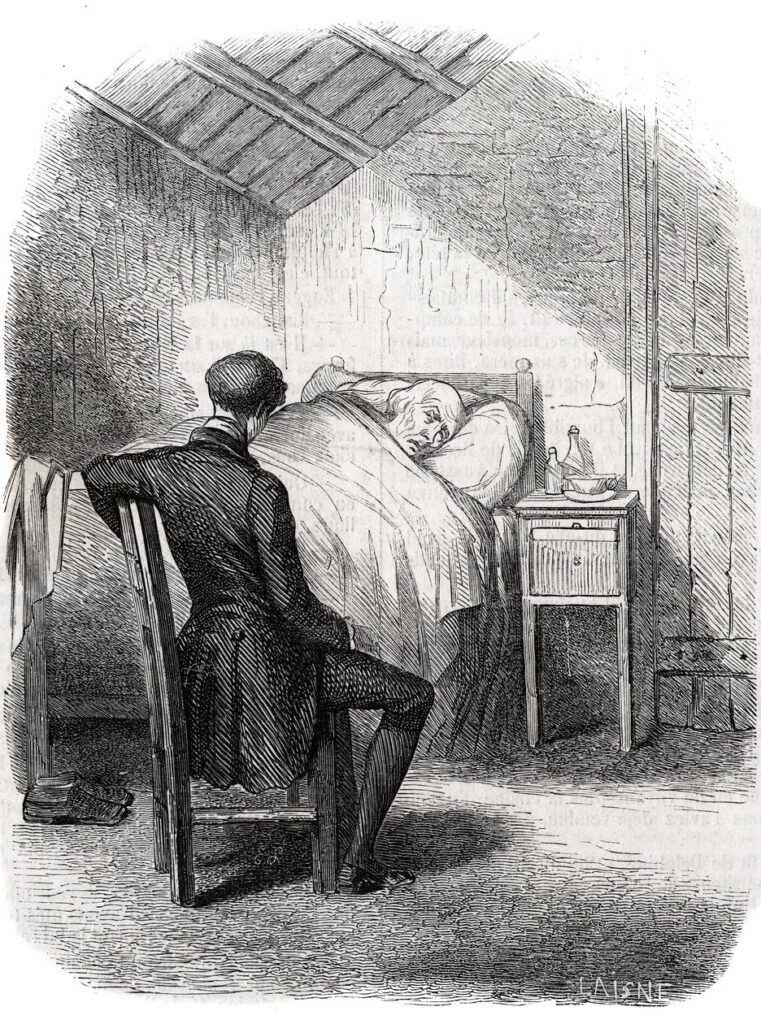
Photo: Meisterdrucke
Desire is not reality, however. For Balzac, Goriot’s death and Beauséant’s decision to “bury [herself] in the remotest part of Normandy” are symptoms of a profound social transformation, through which “deep and noble feeling” is dying out and money has become “the mainspring of everything” (281, 275, 248-9). In the run-up to the deathbed scene, the narrator tells us that Rastignac’s “education was nearly complete,” that he “already loved selfishly,” and that he had accepted Delphine’s “stepping over her father’s dead body” to go to Madame de Beauséant’s ball (278, 270, 271). Ironically, it is Goriot who helps seal this transformation when Rastignac’s “last doubts” vanish at the sight of the new rooms he will share with Delphine (242).
Old Goriot ends with Rastignac standing alone in the Père-Lachaise cemetery after Goriot’s funeral and looking down on Paris “lying tortuously” before him (304; my translation). Having shed at Goriot’s grave “the last tear of his youth,” which “had its source in the sacred emotions of an innocent heart,” Rastignac fixes his gaze on the “splendid world” of gilded Paris:
He eyed that humming hive with a look that foretold its despoliation, as if he had already felt on his lips the sweetness of its honey, and said with superb defiance,
‘It’s war between us now!’
And by way of throwing down the gauntlet to Society, Rastignac went to dine with Madame de Nucingen. (304)
What is arguably Balzac’s most accomplished novel ends on the closure of Rastignac’s “education” but leaves very much open the question of his subsequent success, as he seeks to engage in a one-on-one struggle—the declaration of war is an artifact of the English translation—with Parisian society. But in portraying Paris here in a pose that contemporary readers would have recognized as that of Ingres’ Grande Odalisque, Balzac echoes that aspect of the novel most problematic for modern readers—its patently retrograde gender politics.
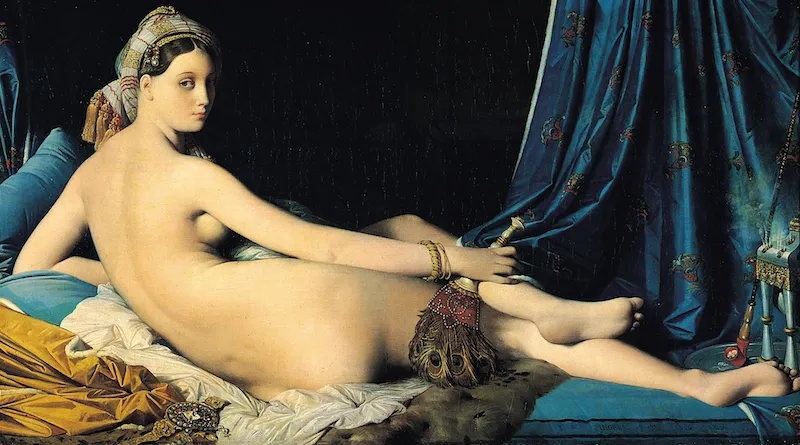
Photo: Jean-Baptiste-Dominique Ingres, Une Odalisque
With the exception of the scenes with Madame de Beauséant, which lead Rastignac to confront the “ideas of honour which make women so great, combined so strangely with the disclosure of the transgressions which society, as it is presently constituted, forces on them,” women in Old Goriot tend to appear either as angels (Victorine), as courtesans (Delphine, Anastasie), and/or as temptresses: “A woman’s disturbing influence had brought confusion to [Rastignac’s] world; [Delphine] had eclipsed his family, and made his entire being subservient to her ends” (272). On countless occasions, moreover, Balzac’s narrator or characters opine in cringeworthy ways on the question of ‘what women want’.
If the attainment of wisdom necessarily entails great attention to the common good, nothing would be easier than to dismiss Old Goriot as a wisdom narrative to the extent that it flattens out the life experiences of most of its female characters. But there is a second reason to question the novel’s pretensions to wisdom. With its insistence that money has become “the mainspring of everything,” Old Goriot exemplifies what critic György Lukàcs has called the “novel of disillusionment,” a representation of “the tragic self-dissolution of bourgeois ideals by their own economic basis” (98). Rastignac’s friendship with Goriot, and especially his experience at Goriot’s deathbed, clearly point him in the direction of a nobility and respect for the family that are more bourgeois than aristocratic. But the lesson does not take. If the ending as written can be read as a pensive one, leaving open the possibility that Rastignac’s (much compromised) nobility of character might win out in the end, his subsequent appearances in Balzac’s work put paid to that hope. Over the course of Balzac’s Comédie Humaine, including the unfinished Le Député d’Arcis, we see Rastignac secure a cabinet position for himself, become a Count, and ensure good marriages and postings for his siblings. He leaves Delphine but commits fraud with her husband and ultimately marries their daughter.
Should we conclude that, while Old Goriot shares many of traits of a classic Bildungsroman, the disillusionment at its core, exemplified by Rastignac’s decision to give free rein to his unscrupulous ambition, lands it squarely on the side of unwisdom? I believe not, for the simple reason that no reader on closing the book can forget the lesson of the death of the novel’s title character.
In S/Z, his masterful unpacking of Balzac’s short story “Sarrasine”, Roland Barthes famously claimed that rereading “alone saves the text from repetition (those who fail to re-read are obliged to read the same story everywhere)” (15f.). In the case of Old Goriot, we cannot fully understand the novel’s final pages without rereading its opening. There, having speculated that “some tears may be shed over [the novel] in the reading—inter muros et extra,” the narrator asks:
Will it be understood outside Paris? One may doubt it. Only between the heights of Montmartre and Montrouge are there people who can appreciate how exactly, with what close observation, it is drawn from life.
They live in a valley of crumbling stucco and gutters black with mud, a valley full of real suffering and often deceptive joys, and they are so used to sensation that it takes something outrageous to produce a lasting impression. Yet now and then in some overwhelming tragedy evil and good are so strangely mixed that these selfish and self-centered people are forced to pause in their relentless pursuit of their own affairs, and their hearts are momentarily touched; but the impression made on them is fleeting, it vanishes as quickly as a delicious fruit melts in the mouth. The chariot of civilization, like the chariot of the Juggernaut, is scarcely halted by a heart less easily crushed than the others in its path. It soon breaks this hinderance to its wheel and continues its triumphant course.
And you will show the same insensibility, as you hold the book in your white hand, lying back in a softly cushioned armchair, and saying to yourself, “Perhaps this one is amusing.” When you have read of the secret sorrows of old Goriot you will dine with unimpaired appetite, blaming the author for your callousness, taxing him with exaggeration, accusing him of having given wings to his imagination. But you may be certain that this drama is neither fiction nor romance. All is true, so true that everyone can recognize elements of the tragedy in his own household, in his own heart perhaps. (27f.)
These utterly brilliant paragraphs lay out a founding paradox: the story of old Goriot—that “heart less easily crushed” by the “chariot of civilization”—can only be appreciated by those who inhabit Paris, but their “selfish and self-centered” nature is such that they will only be “momentarily touched.” It matters not whether one lives amidst the “crumbling stucco and gutters black with mud” of the 5th arrondissement, site of the Maison Vauquer, or in the glittering salons of the 7th, relentless pursuit of self-interest breeds an indifference potentially fatal to the narrator’s dramatic aim. The clearly aristocratic and feminine implied reader is not quite “lying tortuously” in her “softly cushioned armchair,” but the insistence that she will “dine with unimpaired appetite” at the conclusion of the book is, on rereading, an obvious reference to the dinner with Delphine that Rastignac anticipates in its final sentence. In short, the story of old Goriot is framed by challenges: Rastignac’s throwing down the gauntlet to a feminized Paris at the end only comes clear with, and is subservient to, the challenge that the novelist had previously issued to his implied reader—to both understand the tragedy of Goriot and recognize elements of it “in his own household, in his own heart perhaps.” Rastignac gives up on his chance for wisdom, but Balzac clearly holds out hope, against considerable odds, for his implied reader.
