

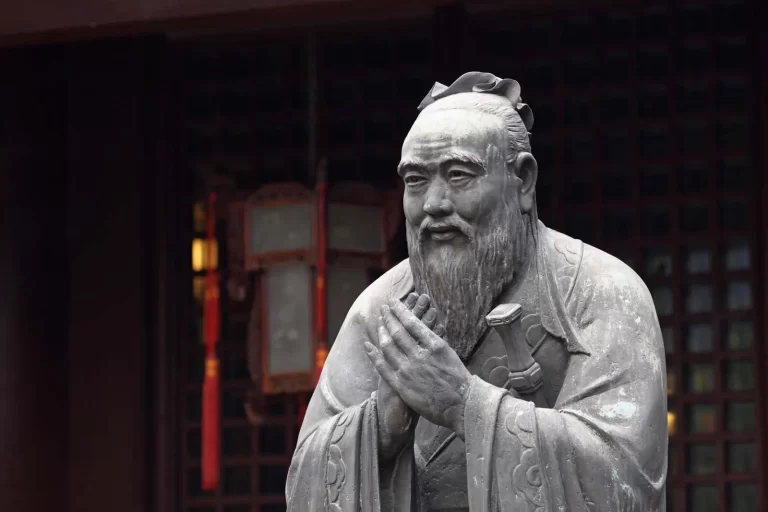
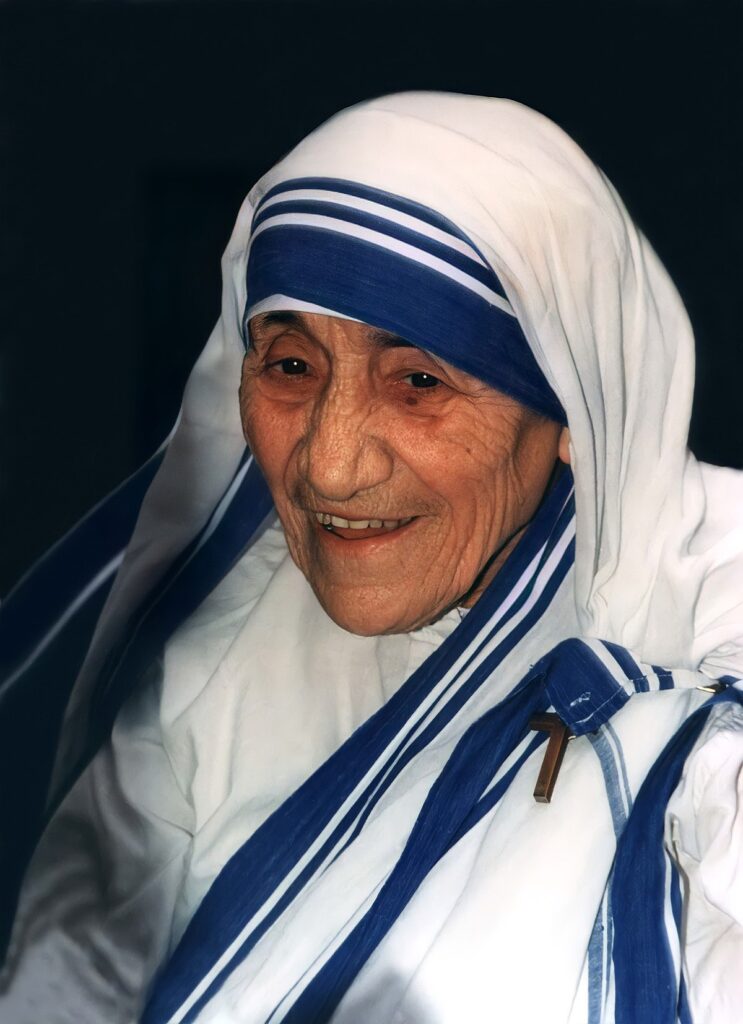

Picture in your mind a wise man or wise woman. Chances are you imagined someone of advanced age—Dumbledore not Harry Potter, The Matrix’s Oracle not Trinity.
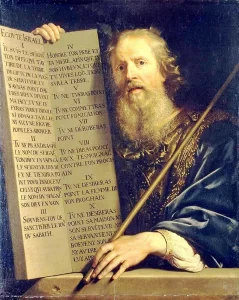
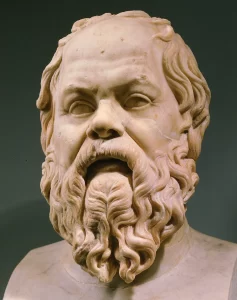
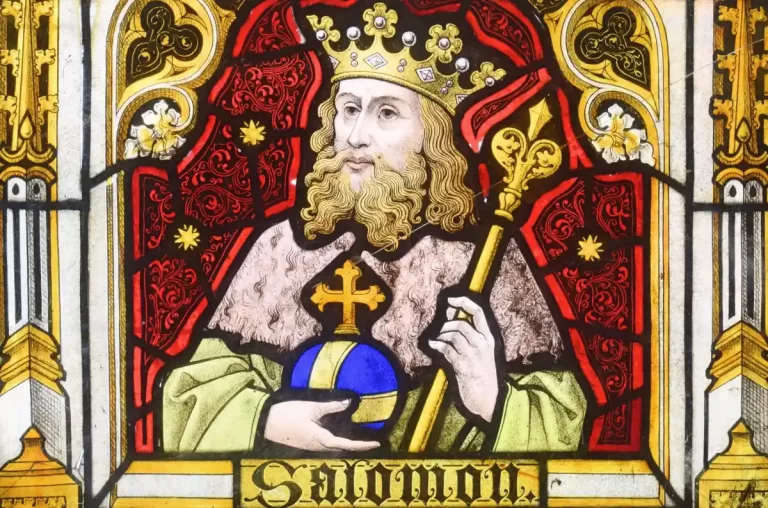
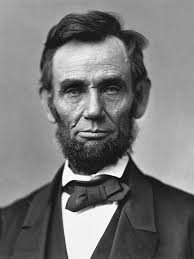
There is, of course, a great deal of cultural tradition behind this linkage, in the West as in the East. The Old and New Testaments are replete with wise elders, including Moses, Abraham, King Solomon, and Saint Paul. But the linkage extends far beyond the Bible. When Robert Sternberg has asked students to name wise people in history, they frequently mention Socrates, Mahatma Gandhi, Nelson Mandela, Mother Teresa, and Ruth Bader Ginsburg; we could surely add Confucius and George Washington to this list (Sternberg and Glück Wisdom 137). The problem is that those same students also mention public figures best known for their work in the prime of life (Jesus, Abraham Lincoln, Barack and Michelle Obama) as well as two women whom the world came to know as teenagers (Malala Yousafzai and Greta Thunberg). Leaving aside the fact that four of these figures were put to death or assassinated, it is clear that the archetypal association of wisdom with age needs serious qualification. Is “older but wiser” directionally correct, even if we can all think of elderly people who aren’t the least bit wise? Or should we rather consider that expression, as Stephen Hall puts it, to be “a pat, self-flattering phrase in the psychological thesaurus of aging narcissists for centuries” (228)?
Here again, Aristotle sets the stage for much of the recent psychological and philosophical work on wisdom. In the Nicomachean Ethics, Aristotle distinguishes between abstract, universal forms of knowledge such as mathematics, in which the young routinely distinguish themselves, and practical wisdom, in which they fall short. Practical wisdom, he contends, is concerned with particulars that “become familiar with experience, but a young man has no experience, for it is length of time that gives experience” (1142a, 14-16). Aristotle’s example is front and center in Schwartz and Sharpe’s work, and specifically in their contention that practical wisdom “is a craft and craftsmen are trained by having the right experiences” (Practical Wisdom 26). The linkage of wisdom and advanced years is likewise sustained by Igor Grossmann’s demonstration that reasoning about intergroup and interpersonal conflicts “improves into old age” (“Reasoning” 7246); by Laura Carstensen’s determination that there is “a steady and marked improvement in emotional experience from early adulthood into old age” (2); and by Susan Bluck and Judith Glück’s finding that life experience brings a greater awareness of the limits of our efforts to control the world around us (Glück 335). Similarly, Erik Erikson’s conception of ego integrity as the fruit of an eighth and final stage of the life process sets the stage for Lars Tornstam’s notion of “gerotranscendence”, whereby many older adults move “from egoism to altruism” and come to enjoy a greater sense of “communion” with others and the world (12).
In the cultures of the West most especially, we tend to associate old age with inevitable loss and decline—of fluid intelligence, working memory, mental flexibility, bodily vitality, and/or overall health. As Grossmann’s and Carstensen’s use of the phrase “into old age” clearly reflects, each of these arguments seeks not to deny but rather to complicate that association.

Photo: Kritikal Solutions
Elkhonon Goldberg’s The Wisdom Paradox approaches the question of wisdom’s association with advanced age from a specifically neuroscientific perspective. Set in motion by a personal brain scan that Goldberg initially thought revealed “mild brain damage,” only to be told that it reflected “just a well-used brain,” his book argues that, despite the inevitability of neuroerosion, “the aging of the mind has its own triumphs that only age can bring” (4, 5, 18). Understanding wisdom as “an extreme form of expertise or competence,” Goldberg celebrates the “instantaneous, almost unfairly easy insight” that accrues to those who have acquired strong cognitive templates, an ability to recognize salient patterns in daily experience through long practice (78, 9). For Goldberg, what sets humans apart is a crystallization of pattern-recognition devices in human culture and symbol systems, and specifically in language as a privileged “repository of the ‘wisdom of the species’” (87, 94). Those of long experience particularly benefit from this crystallization of cultural patterns insofar as the left hemisphere of the brain (where those devices ‘reside’) is less subject than the right to “the decaying effects of age because [the left] continues to be enhanced and strengthened by cognitive activities” (258).
One variant of the wisdom paradox is that, while history is full of what Goldberg calls “late and luminous bloomers”—he mentions Goethe, Gaudí, Grandma Moses, Norbert Wiener, Golda Meir, and Nelson Mandela—it is also replete with “decaying great minds” (Newton, Kant, Michael Faraday) and leaders with an increasingly impaired capacity for decision making (Reagan, Hitler, Stalin) (52ff., 63ff.). Critical in this respect is a well-functioning prefrontal cortex, inasmuch as that cortex is not only the cornerstone of language, but also of several functions essential to wisdom, including empathy and the ability to imagine oneself in another’s shoes, a facility for counterfactual reasoning (including moral reasoning), and a capacity for regret (172). Beyond the obvious point that some individuals never develop much wisdom to lose, the association of wisdom with age is thus complicated by the fact that the region of the brain on which wisdom primarily depends, the prefrontal cortex, is of all the brain’s subdivisions that which is “affected to the greatest extent by aging” (45).
Further nuancing the traditional association of wisdom with age, but consistent with Goldberg’s discussion of the prefrontal cortex, is an increasing body of evidence that “people show the highest levels of wisdom not at age 80 but rather at, say, age 50 or age 60, or even earlier”—i.e., in late middle or early old age (Sternberg and Glück Wisdom 103). If old age brings a demonstrably greater “willingness to make compromises and accept one’s limitations,” it also tends to make one less “open to new experiences,” less able to “think in very complex ways,” and more prone “to gloss over significant problems and conflicts” (Sternberg and Glück Wisdom 104; Glück 341).
Having reviewed the wide range of recent psychological studies on the association of wisdom with age (of which I have only scratched the surface here), Judith Glück writes:
In sum, wisdom increases, stays stable, increases then decreases, decreases then increases, or just decreases with age, depending on which measure you look at. (324)
For example, measures that foreground social and interpersonal conflict resolution or an ability to transcend the self tend to increase with age, whereas those that depend on complex thinking and the management of uncertainty increase dramatically between the ages of 15 and 25, then decrease in old age (328). The development (or not) of wisdom in any one individual is highly dependent on that individual’s mental capacities, mindset, cultural insertion, education, and life experiences, to such a degree that teasing out any one set of factors as determinative across populations can be a fool’s errand. But this “complex interplay of several factors” also bedevils those who would determine a definitive correlation of wisdom with age across groups (328). Once again, the definition of what we mean by “wisdom,” understood in part as a situationally attentive approach to the complexities of the world, is itself a complex, situationally determined endeavor.
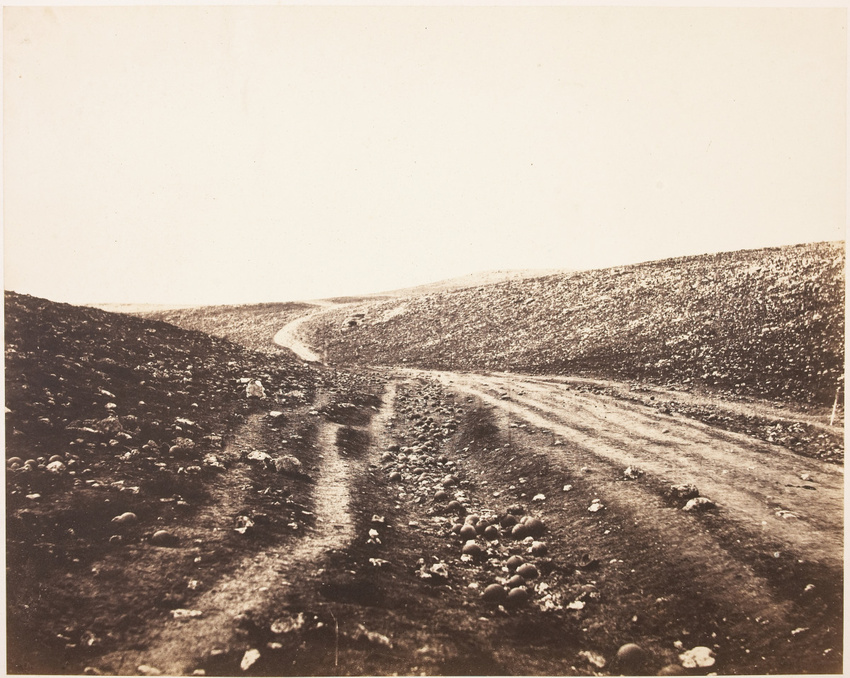
Photo: Roger Fenton, “The Valley of the Shadow of Death”
In Libra, Don DeLillo’s fictional reworking of the JFK assassination, one of the novel’s fictional co-conspirators reflects as follows:
Plots carry their own logic. There is a tendency of plots to move toward death…. A plot in fiction… is the way we localize the force of the death outside the book, play it off, contain it. (221)
I quote this not to slip back into the study of conspiracy-themed narrative, of which Libra is a prime example, but rather to point to how central the desire to work through and “contain” the prospect of death is to the literary enterprise—dramatic and poetic, as well as novelistic. Indeed, I would argue that the prospect of death is, more often than not, a critical step in the coming-into-wisdom of novelistic protagonists. Prior to the battle of Borodino, War and Peace’s Prince Andréi Bolkónsky is cold, vain, and driven by nothing so much as the desire to die a glorious death in battle. But as Andréi watches the sputtering cannonball that would maim and eventually kill him, he experiences a quintessentially Tolstoyan affirmation of life that will carry through the days that remain to him:
“Can this be death?” thought Prince Andrei, gazing with completely new, envious eyes at the grass, at the wormwood, and at the little stream of smoke curling up from the spinning black ball. “I can’t, I don’t want to die, I love life, I love this grass, the earth, the air….” (810f.)
In much of the recent scholarly work on wisdom, the desire for wisdom is presented from the perspective of one whose days are clearly numbered. Here is Stephen Hall:
We crave wisdom—worship it in others, wish it upon our children, and seek it in ourselves—precisely because it will help us lead a meaningful life as we count our days, because we hope it will guide our actions as we step cautiously into that always uncertain future. (6)
Judith Glück makes the point more explicitly still:
Becoming more aware of death may lead us to reevaluate what is really important in life and to find external sources of self-esteem, such as fame or money, less rewarding than an inward focus on reexamining our lived life, improving our relationships with others, and coming to peace with ourselves. (327)
As I write these lines, I am in my late 60s, having recently returned to faculty status after 16 years of administrative service at two institutions, twice as dean, then as provost. My lovely and highly accomplished wife of 40 years was diagnosed with endometrial cancer three years ago, then developed leukemia as a result of the chemotherapy used to treat it. So I have an intense personal investment in the question of how the shadow of death might inform the quest for wisdom in late middle and early old age. But I remain a university professor and so well know how critical the college years are to one’s intellectual, social, and ethical development. Even those who believe that wisdom accrues primarily through life experience tend to concede that the traditional college years—ages 18 to 23—represent a particularly auspicious time to lay the foundations of wisdom.
In their seminal paper from the year 2000, “Wisdom: A Metaheuristic (Pragmatic) to Orchestrate Mind and Virtue Toward Excellence,” Paul Baltes and Ursula Staudinger contest the prevalent view that wisdom increases with age, highlighting the age range from 15 to 25 as “the major period of acquisition of wisdom-related knowledge and judgment before early adulthood” (128). Of particular interest in this paper is the finding that young adults and (even more so) older adults perform better on wisdom tasks when given the opportunity to discuss the problem “with a significant other before responding individually” (130).
What we will see in the readings that comprise this section, and indeed throughout this blog, is that texts rich in wisdom tend to thematize wisdom’s acquisition as a dialogue—explicit or implicit—between a younger and an older individual. We will see instances where the young benefit, as tradition would have it, from the wisdom of their elders, typically as the latter face the prospect of death. But, consistent with Baltes and Staudinger’s finding, we will also encounter a novel—Ruth Ozeki’s A Tale for the Time Being—in which it is the elder partner in the dialogue who benefits most notably. At its best, in other words, wisdom’s dialogue cuts both ways.
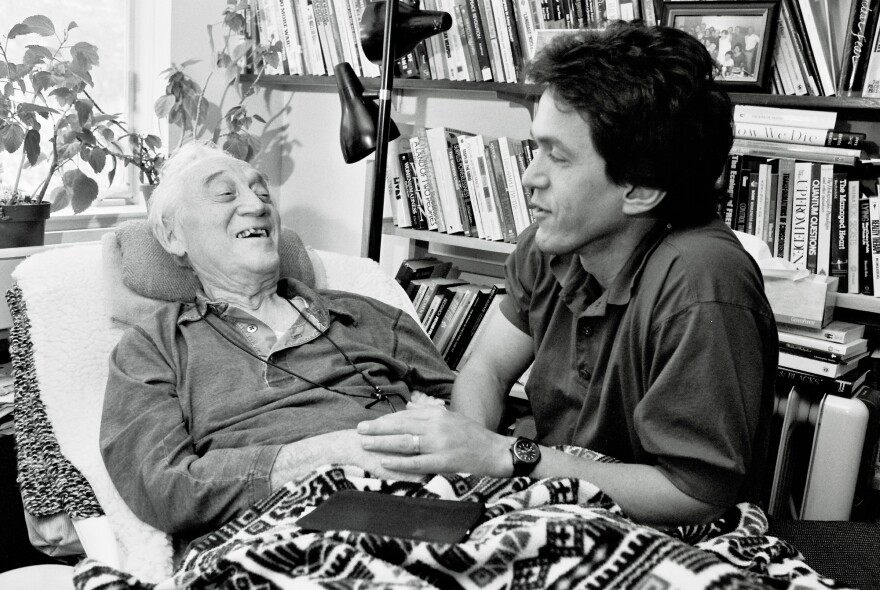
Photo: Iowa Public Radio
To set the stage for how certain novels thematize this dialogue, I will begin with a relatively traditional, non-fiction exemplar, Mitch Albom’s best-selling Tuesdays with Morrie, with its highly appropriate subtitle: An Old Man, a Young Man, and Life’s Greatest Lesson. In his late thirties and already a successful sportswriter, Mitch happens upon an interview on Ted Koppel’s “Nightline,” in which his favorite college professor, Brandeis sociologist Morrie Schwartz, shares his thoughts on life and his struggles with ALS (a.k.a. Lou Gehrig’s disease). Feeling sheepish for having lost touch with his college mentor, Mitch arranges a visit, then 14 more visits on consecutive Tuesdays, for what he calls the “last class of my old professor’s life,” a class on “The Meaning of Life” and “taught from experience” (1).
Across a series of dialogues on such topics as the emotions, forgiveness, regrets, death, and the fear of aging, Mitch comes to see that he had become far “too wrapped up in the siren song of my own life,” burying himself in his professional accomplishments, “because with accomplishments, I believed I could control things” (33, 17). But this culture of work, with its endless deferral of present experience and its illusory sense of control, is but one aspect of a contemporary culture that, as Morrie puts it, “does not make people feel good about themselves” (42). In late 20th-century America, Morrie suggests, “the young are not wise” and have “little understanding about life” because they are the unwitting subjects of consumerist manipulation—“buy this perfume and you’ll be beautiful, or this pair of jeans and you’ll be sexy” (118). But so too are all of us who have been brainwashed (Morrie’s word) to believe that “More is good,” be it money, property, or just plain stuff (124). “Wherever I went in life,” Morrie tells Mitch,
I met people wanting to gobble up something new…. These were people so hungry for love that they were accepting substitutes. They were embracing material things and expecting a sort of hug back. But it never works. (125)

Photo: Picturing the American Dream
In contrast to the fevered quest for control and fulfillment through work and acquisition, Morrie had “developed his own culture,” creating “a cocoon of human activities—conversation, interaction, affection—[that] filled his life like an overflowing soup bowl” (42f.). Rather than sleepwalk one’s way through a meaningless life, Morrie counsels, “devote yourself to loving others, devote yourself to the community around you, and devote yourself to creating something that gives you purpose and meaning” (43). Become “more involved in your life while you’re living,” more present to others and the possibility of new experiences (81). But the best way to do this is to “know you’re going to die, and to be prepared for it at any time” (81). Morrie may have made death “his final project,” but it was always in the interest of a life well lived (9).
I have spoken of wisdom as a dialogue between two ages, but Tuesdays with Morrie more accurately involves a dialogue between four—between the terminally ill Morrie, Mitch the narrator, Mitch the careerist sportswriter, and Mitch the former student. In a moving letter to his agent explaining the concept of his book, narrator Mitch writes: “I find myself drawn to [Morrie], his strength and his wisdom, which seem to grow exponentially as he gets closer to the end” (201). Reflecting on his earlier encounters with Morrie, this Mitch speaks of the privilege of being mentored by a teacher “who saw you as a raw and precious thing, a jewel that, with wisdom, could be polished to a proud shine” (192). Above all, however, Tuesdays is a dialogue between two Mitches:
I look back sometimes at the person I was before I rediscovered my old professor. I want to talk to that person. I want to tell him what to look out for, what mistakes to avoid. I want to tell him to be more open, to ignore the lure of advertised values, to pay attention when your loved ones are speaking, as if it were the last time you might hear them. (190)
The shadow of death is clarifying, in other words, even (and perhaps especially) for those far from the burdens of old age.
Tuesdays with Morrie is a heartfelt and moving example of an explicit wisdom dialogue. Its commercial success—including 23 weeks as #1 on the New York Times best-selling non-fiction list—speaks to a hunger for wisdom at the turn of the millennium. But it is missing something that strong novels often convey: a sense that both individual characters and the cultures that sustain them are scenes of a struggle between competing values, unfolding over time. Mitch’s Conclusion, which begins with the passage I just quoted, presents the lesson of his conversations with Morrie as static and final, leaving the reader wondering how that lesson might have informed (or not) Mitch’s later life. The novelistic plot moves toward resolution, “toward death” in DeLillo’s formulation. And yet, ironically, it is often used to signal that any resolution is necessarily incomplete. That is one lesson of Honoré de Balzac’s Old Goriot, to which I now turn.
