A worldview that sees the world as perfect at every moment through a coincidence of opposites and an insistence on absolute simultaneity leaves no place for action in the world, specifically in the pursuit of social justice.
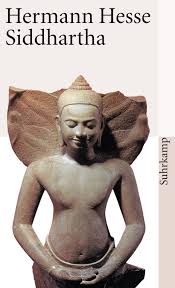
Like The Alchemist, Hermann Hesse’s Siddhartha tracks the quest for a “primal source in one’s own self,” suggesting that everything else “was seeking, was detour, was confusion” (7). But here, wisdom is more overtly the product of dialogue and shared experience. Rather than highlight a single journey, Siddhartha traces the interlocking journeys of four of its characters: Siddhartha himself, his childhood friend Govinda, his longtime lover Kamala, and their son Siddhartha. Much of the novella’s interest with respect to wisdom derives from Hesse’s skill in playing these quests off one another, and off the already realized quest of the wandering Buddha—who may be, as Ralph Freedman argues, “actually the foremost character in a concealed, almost subversive role” (xxv).
Siddhartha’s journey unfolds in a patently dialectical way, with each phase seeking (if not always succeeding) in overcoming the deficits of the prior phase. At the novella’s outset, Siddhartha is an accomplished, beautiful, and well-bred Brahmin son, adept in verbal battle with his friend Govinda and well-versed in the practice of the Om, Hinduism’s sacred syllable that contains all things (3). Though Siddhartha’s accomplishments bring great joy to others, he himself feels no joy—in part because “any attained wisdom merely triggered new thirst in him,” in part because the Brahmins, priests, and sages from whom he has learned, starting with his father, have not yet lived the deep knowledge they possess (6). The knowledge of Atman—the concept of a universal self that lives on past death—“has no worse enemy,” he argues, “than the wish to know, than learning” (18).
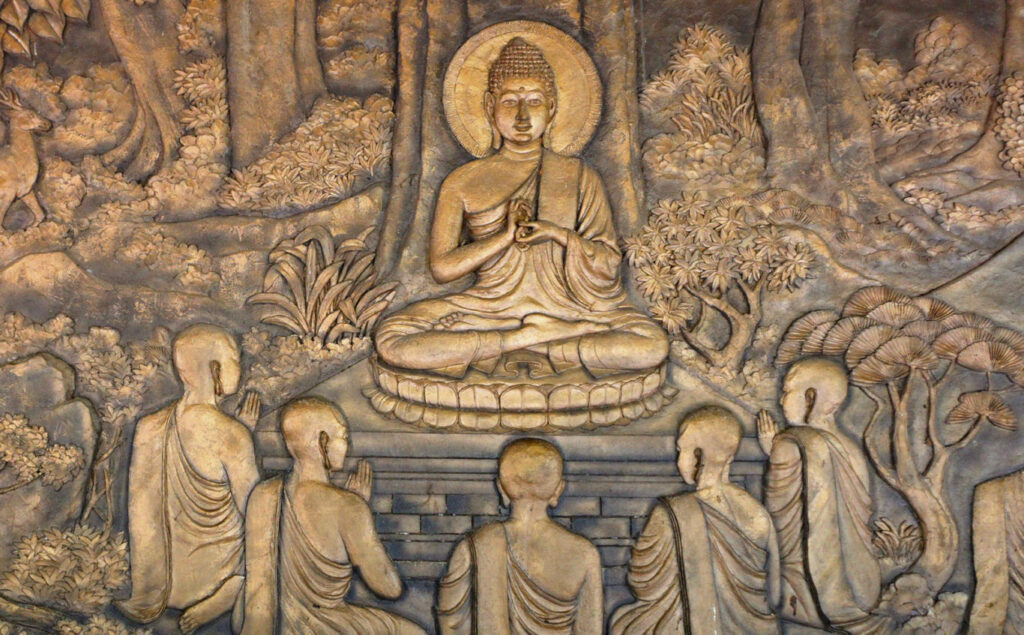
Photo: Anandajoti Bhikkhu
Accompanied by Govinda, Siddhartha renounces his life of Brahmin privilege and becomes—much like Siddhartha Gautama (a.k.a. the Buddha) before him—a wandering monk. Among the ascetic samanas, Siddhartha seeks to “become empty—empty of thirst, empty of desire, empty of dreams, empty of joy and sorrow” (13). In his time among the samanas, however, he discovers that this rejection of his Brahmin upbringing through “pitiless unselfing” and “devastating service” had left him still “far from wisdom”: “But though the paths [he followed] led away from the ego, in the end they always led back to the ego” (8, 17, 15).
Intrigued by the growing legend of a former ascetic who was himself “crisscrossing the land” spreading his “sublime teaching,” Siddhartha and Govinda leave the samanas to hear from Gautama, the Buddha, whom they find bathed in “an everlasting calm, in an everlasting light, an inviolable peace” (20, 33, 26). In Gautama’s presence, Siddhartha finds that he has never “loved a human being so deeply” (27). He recognizes that Buddha’s teaching captures “the unity of the world, the coherent togetherness of all events, the unfolding of everything, big and little, in the same river” (31). To the Buddha himself, however, he vows to continue his wandering, “to leave all teachings and all teachers and to reach my goal alone or die,” arguing that Gautama’s own illumination did not come from a teaching but from listening to “a voice in his own heart” (33, 45). Thinking no doubt of his Brahmin past, Siddhartha speaks of the risk that he will make the Buddha’s teaching, his love for the Buddha, and the fellowship of monks “into my ego,” to which Gautama replies: “Beware of too much cleverness!” (33f.). Behind this somewhat enigmatic reply, I suspect, lies the Buddha’s recognition that there is no small measure of ego behind Siddhartha’s lack of faith in the words of teachers and his sense that the Buddha could not “teach him anything new” (21, 27).
In childhood, Govinda happily lived “as [Siddhartha’s] friend, as his companion, as his servant, as his lance bearer, as his shadow” (4). Even in the samana phase of his journey with Siddhartha, he always wanted to live in the aura of his friend’s future greatness (16). When Siddhartha leaves Gautama to resume his quest, however, Govinda stays behind, confident that he has found in the teachings of the Perfect One precisely what he craves.
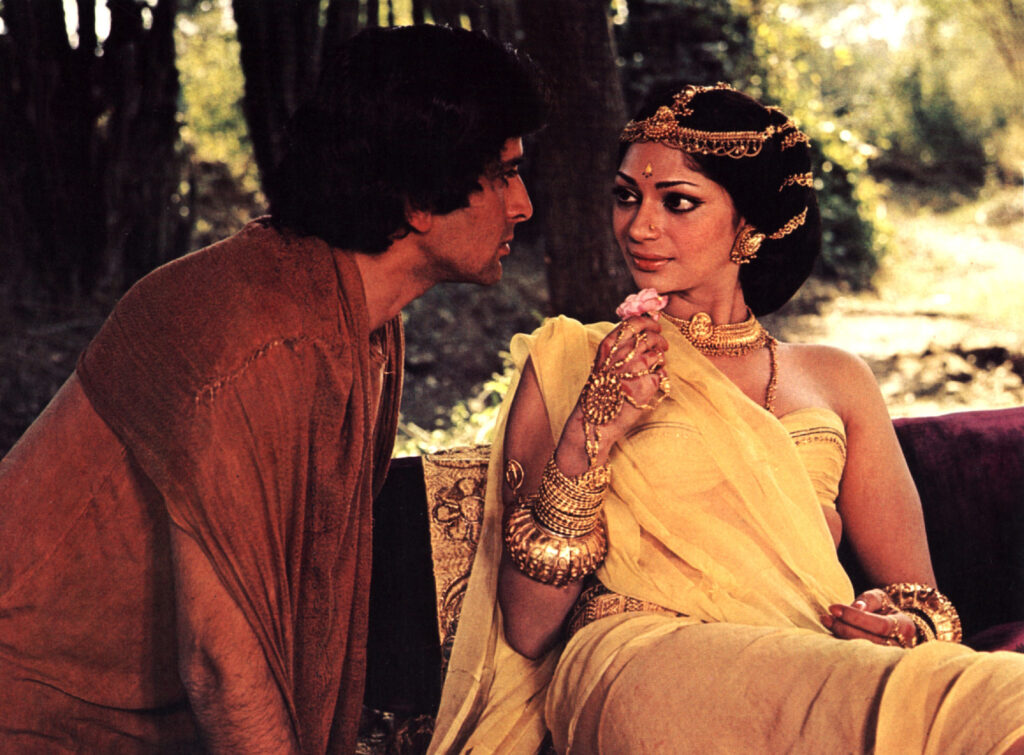
Photo, Siddhartha (1972), dir. Conrad Rooks
Having concluded that the “world of thought… led to no goal if one killed the random ego of the senses while fattening the random ego of thinking and learning,” Siddhartha finds himself reborn when he opens himself back up to a childlike appreciation of the “enigmatic and magical” diversity of the physical world (45, 37). He meets the courtesan Kamala and, at her urging, grows rich through an apprenticeship, then a partnership with the merchant Kamaswami. Thanks to the “wise” Kamala’s “teaching”, he learns “the art of which [she is] mistress”—the “cult of pleasure, in which… giving and taking become one” (53, 64). In his business dealings as in his daily existence, he is surrounded by “people living in a childlike and animal fashion, which he both loved and despised,” but which failed to speak to his heart (62ff.). After many years among these so-called child people, he finds his soul to have been rotted by “worldliness and slothfulness” and condemns himself for playing the “superior man that he no longer was” (67, 72). On Kamala’s beautiful face and in his own heart, he comes to read a secret anxiety, a fear of old age and death (72).
Lost and forlorn, Siddhartha returns to the river he had crossed after leaving the Buddha. Gazing into its waters in a moment of “utter hopelessness and helplessness,” he “leaned toward death,” but is saved when he hears the sacred Om from deep in his soul (86, 78). After a brief encounter with Govinda, who continues on his path, Siddhartha concludes: “I had to go through so much stupidity, so much vice, so much error, so much disgust and disillusion and distress, merely in order to become a child again and begin afresh” (85). Having now experienced—rather than simply known—the vanity of riches and earthly pleasures, he finds that “his small, proud, anxious ego” has finally died (87). Overcome by a surge of joy, he pledges: “No, never again, much as I liked to do it, will I ever imagine Siddhartha is wise!” (85f.).
So begins Siddhartha’s years-long apprenticeship with the ferryman Vasudeva and with a river that gazes at him “with a thousand eyes” and is “always and forever the same, and yet new every instant” (89). From Vasudeva and the river, he learns to listen “with a silent heart, with a waiting, open soul, without passion, without desire, without judgment, without opinion” (94). He experiences a blissful sense of illumination in recognizing that all fear, self-torment, and hostility—including the fears of death and aging—can be surmounted by overcoming time, as the river does in its exemplifying of pure presence. Hearing the sacred Om in all of the river’s 10,000 voices, Siddhartha realizes that he is “no longer separated from Gautama, whose Teaching he had been unable to accept,” nor “from all the thousand others who live in the eternal, who breathed the divine” (95, 97).

Photo: G.C. Myers, Ferryman, Redtree Times
If the river thus stands as the ultimate symbol of the oneness of life, it is also the place at which the paths of Siddhartha’s four questers ultimately cross. After vowing to follow the Buddha and gifting her pleasure garden to his followers, Kamala sets out, with the son that Siddhartha did not know he had, to find the Buddha. But she is fatally bitten by a snake and finds Siddhartha instead (100). Watching over Kamala on her death bed, Siddhartha feels himself fully permeated by a “feeling of the present and simultaneity… the eternity of every instant” (100).
Distraught over Kamala’s death, Siddhartha seeks to integrate their son into the ferryman life. But the eleven year-old is a “pampered boy… brought up in the habits of wealth” (105). With a heart that is “too hard and proud,” he denies Siddhartha’s paternity (108). Vasudeva encourages Siddhartha to let his son return to town to find his own path, as Siddhartha himself had found his, but Siddhartha resists, cherishing “the sorrow and suffering of love more than joy and happiness without the boy” (105ff., 103). Recalling Kamala’s having pronounced him incapable of love, he discovers that, in his love and suffering for his son, he “had become a child person… yet he was blissful” (107). When the son flees to town, Siddhartha follows, only to abandon his pursuit at Vasudeva’s urging.
Now “close to perfection” yet still enduring the “final wound” that was the loss of his son, Siddhartha feels himself growing “similar to the child people. / He now saw people in a different light, less cleverly, less proudly, but also more warmly, more curiously, more sympathetically” (113). But the child people lack “one tiny little thing… the conscious thought of the oneness of life”:
Slowly blossomed, slowly ripened in Siddhartha, the insight, the knowledge of what wisdom actually is, what the goal of his long seeking was. It was nothing but a readiness of the soul, an ability, a secret art, to think the thought of oneness, to feel and breathe the oneness at every moment, in the midst of life. (114)
Having listened to the river laugh at the eternal return inherent in his repetition of his father’s sorrow when he first left to join the samanas, Siddhartha then sees all images of his past—“ardent, desiring, suffering”—merge into the river’s flow, rejoining the eternal cycle of life in which river water turns to vapor, to rain, and back again: “And all of it together, all voices, all goals, all yearnings, all sufferings, all pleasures, all good and evil—the world was everything together. Everything together was the river of life, was the music of life,” encapsulated in “a single word, which was ‘om’: perfection” (118f.) At this, Siddhartha’s “wound blossomed, his sorrow was radiant, his ego had flowed into the oneness” (119).

Photo: Umastro
After an ailing but radiant Vasudeva opts to disappear “into the forest, into the oneness,” Govinda returns to the river and, for a second time, initially fails to recognize in the ferryman his old friend Siddhartha (120). Although revered for his age and modesty, Govinda has not yet snuffed out the “disquiet and seeking” in his heart and asks for a teaching, to which Siddhartha responds that he is seeking too strenuously and that the
[w]isdom that a wise man tries to communicate always sounds foolish…. Knowledge can be communicated, but not wisdom. We can find it, we can live it, we can be carried by it, we can work wonders with it, but we cannot utter it or teach it. (124)
Conscious of the irony that he is trying to communicate “the secret meaning” in words that are not up to that task, Siddhartha gives Govinda his “best thought”—namely, that the “opposite of every truth is just as true…. A truth can be uttered and clad in words only if it is one-sided” (126, 124). Of the Buddha’s distinction between samsara and Nirvana, he says: “Never is a man or a deed all samsara or all Nirvana, never is a man all saintly or all sinful” (124). To think otherwise is to fall “prey to the illusion that time is a reality” (124).
“No, the world is perfect at every moment, all sin contains all grace, all youngsters already contain oldsters, all babies contain death, all the dying contain eternal life.” (125)
Having thus outlined his disagreement with the Buddha, Siddhartha then characterizes it as a “fight over words,” and hence “an illusion,” and again reiterates his conviction that Gautama’s greatness lies “not in speaking, not in thinking, but only in doing, in living” (128f.).
As he prepares to leave yet again, Govinda concludes that Siddhartha’s “thinking sounds foolish” and that the “pure Teaching of the Sublime One sounds… clearer, purer, more intelligible” (129). Asked to kiss Siddhartha’s forehead, however, Govinda suddenly sees in Siddhartha’s face
a streaming river of faces… which all came and faded, and yet seemed all to be there at once, which kept changing and kept being renewed, and yet which all were Siddhartha…. And Govinda saw that… [Siddhartha’s] smile of oneness over the streaming formations, this smile of simultaneity over the thousand births and deaths was… exactly the identical still, fine, impenetrable, perhaps kindly, perhaps quizzical, wise thousandfold smile of Gautama, the Buddha…. This, Govinda knew, was how the Perfect Ones smiled. (130f.)
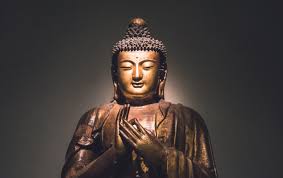
Photo: Tricycle: the Buddhist Review
The tale ends with Govinda bowing low before Siddhartha, as a feeling “of humblest veneration burned in his heart like a fire” (131).
Of all the various works I am examining here, Siddhartha is arguably that which most explicitly focuses on a successful quest for wisdom. Its resonance in post-60s America and in India has been impressive. And yet—for this reader at least—it leaves many essential questions open for debate.
I have spoken of the irony, which Siddhartha recognizes, of his downplaying the very words with which he attempts to communicate the secret meaning he is privy to. That irony is of course all the more acute for Hesse himself, the author of a powerful novella that is nothing but words and in which wisdom dialogues are ubiquitous, but whose “best thought” suggests that words can only capture one side of the truth.
In many respects, this irony around the power of words is subservient to a larger irony around the power of teaching. Googling “Siddhartha wisdom,” or even “Hesse wisdom” will nearly always land you on some variant of Siddhartha’s claim to Govinda that “[k]nowledge can be communicated but not wisdom” (124). And yet, long after he has renounced teachings of all kinds, Siddhartha seeks out teachers. Kamala explicitly teaches him the art of love; Vasudeva and the river teach him of the eternal oneness of the world. And it is patently the case that Siddhartha‘s historic resonance derives from readers’ perceptions that they can learn from its wisdom.
I would argue that the key passage for unpacking this irony around teaching comes at the novella’s end, with Govinda’s final vision. In seeing Siddhartha’s face as a streaming river of faces, eternally changing yet all-present, Govinda repeats on a cosmic scale Siddhartha’s vision of his own life in the river. Suddenly, Govinda’s sense that the Buddha’s teaching was clearer, purer, and more intelligible vanishes. In his final bow before Siddhartha, “whose smile reminded him of everything that… had ever been valuable and holy to him in his life,” this eternal disciple recognizes that Siddhartha has become the Buddha and that the vision that Siddhartha wordlessly imparts is a form of pure Teaching worthy of the Sublime One. The French psychoanalytic theorist Jacques Lacan famously described how the analyst who denies knowing the truth of a patient’s desire is elevated into the position of the “subject supposed to know” that very truth (232). Wittingly or not, Siddhartha becomes the ultimate teacher, the very incarnation of wisdom in the world, in definitively renouncing both his ambition to be wise and his role as a teacher.

Photo: Platonic Zen
This paradox speaks to two elements—intellectual humility and empathy—that I have argued are essential to the acquisition of wisdom. Siddhartha’s commitment to killing his “small, proud, anxious ego” leads him to renounce several iterations of his former self, but there is nothing particularly humble about setting oneself up as a window onto the eternal oneness of all existence and as a functional equivalent of the Buddha. This is why—to this reader at least—Siddhartha is rarely an object of readerly empathy. He is prideful when we first meet him as a young boy and feels prideful—albeit differently—at the end.
Above all, where Siddhartha falls short of what I take to be wisdom lies in its insistence that wisdom is achieved through an overcoming of time. As we have seen, the notion of a character’s development over time is central to the Bildungsroman and its many variants (the coming-of-age novel, novel of education, artist’s novel, etc.). Siddhartha itself tracks its title character’s progress toward illumination over the course of a lifetime. I can live with that paradox. After all, wisdom’s injunction to be sensitive to the complexities of human existence entails an openness to paradox, irony, and seeming contradiction. But Siddhartha goes farther. To insist that “[n]ever is a man or a deed… all saintly or all sinful” is by no means to demonstrate that time is but an illusion (124). Wisdom, as I understand it, is precisely an ability to tease out the complex mixture of saintliness and sin in persons or actions as they unfold over time. A worldview that sees the world as perfect at every moment through a coincidence of opposites and an insistence on absolute simultaneity leaves no place for action in the world, specifically in the pursuit of social justice.
In subsequent posts, I will explore the implications for wisdom and culture of theologian Reinhold Niebuhr’s Serenity Prayer, commonly phrased as: “God, grant me the serenity to accept the things I cannot change, / the courage to change the things I can, / and the wisdom to know the difference.” As manifested in Govinda’s vision, Siddhartha’s final teaching denies the very possibility of change and so takes a risk of quietism to which Niebuhr’s formulation brilliantly responds to its absolutist extreme.
