Photo: News Medical
Wisdom as I understand it is a capacity for sound judgment with a view to pragmatic action. Wise judgment is attuned to cognitive complexities in the world and to the ways in which historical and cultural contexts inform diverse systems of value. Whatever their domain of action, wise practitioners evince high degrees of intellectual humility and empathy, together with a thoroughgoing commitment to fostering the well-being of both one’s self and one’s community.
The Oxford English Dictionary defines wisdom in the first instance as the “capacity of judging rightly in matters relating to life and conduct.” I have a problem with “rightly” in this context. “Soundly” would be preferable since wisdom is never more valuable than in situations where there is no single correct answer. But with its insistence on the centrality of judgment and action in the world, the OED’s definition captures much of what “wisdom” has come to mean in the post-Aristotelian, secular West.
Problems begin to emerge, however, as soon as one probes a bit deeper. Wisdom clearly depends on deep factual knowledge and sound reasoning, but emotional intelligence also plays an undeniable role. Wisdom draws on our mental capacities, but also on character traits such as “courage, patience, self-control, and kindness” (Schwartz and Sharpe Practical Wisdom 45). We tend to think of wisdom as the province of individuals, yet it (and its antithesis) are very much embedded in the cultures that shape them. Although frequently thought of as knowing how to live well, wisdom is no less often associated with pursuit of the common good. The wise individual knows much, but also knows just how little she knows. Wisdom involves learning from the past, but also knowing that the future may look very different. Because it is fostered by long experience, wisdom is typically associated with old age, but we all know wise adolescents (think Greta Thunberg or Malala Yousafzai). Wisdom is made manifest by action in the world, but also occasionally by timely inaction. In short, wisdom is a fundamentally, even essentially vexed concept, one that bears within itself a long list of apparent tensions—between reason and emotion, mind and character, self and other, self-interest and social interest, knowledge and uncertainty, past and future, experience and passion, action and inaction, and so forth. These tensions point us toward the first of what I take to be the five primary markers of wisdom—namely, sensitivity to (and the appreciation of) fundamental complexities.
Complexity and Nuance
We do not need wisdom when the choices before us are clear. Wisdom comes into play when we must balance competing values, priorities, or perspectives in a constantly changing world, in order to arrive at the best possible course of action. The exercise of wisdom thus depends upon a tolerance for, and understanding of, situational complexity, uncertainty, ambiguity, ambivalence, irony, paradox, and contradiction. Wisdom’s exercise, in other words, draws on an appreciation for nuance and complexity much like that complexity intrinsic to the very concept of wisdom. Where the paranoid style largely sees the world in black and white and history as an eternal struggle between good and evil, the practice of wisdom (and wisdom studies by extension) is attuned to their many shades of gray. As H.L. Mencken once quipped: “For every complex problem there is an answer that is clear, simple, and wrong” (qtd. in Collins 218).
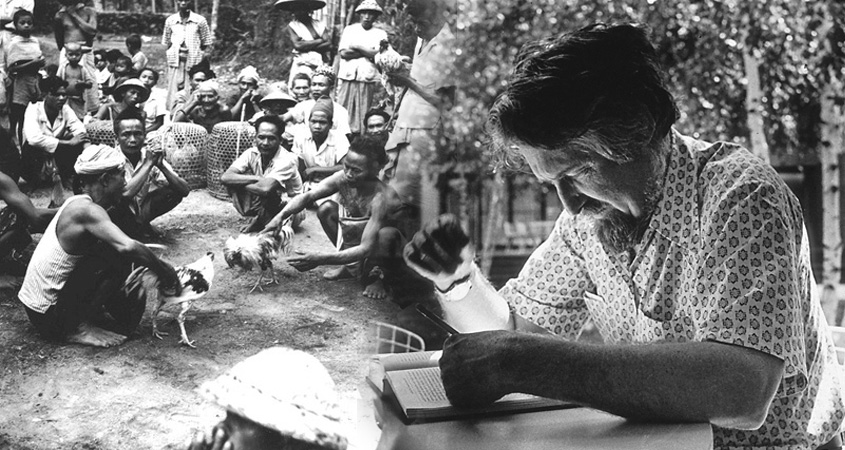
Photo: Stephen Jones
As my last two paragraphs suggest, wisdom tends to demand what Clifford Geertz famously called “thick description,” both in the unfolding of what we mean by “wisdom” and in determining how best to move forward in the complex circumstances of practical life (7). I will be arguing that narrative—be it in the form of novels, plays, films, graphic memoirs, or simple stories—is an important, even essential tool for describing opportunities for wisdom thickly.
To stick with the complexity of “wisdom” for the moment, consider that a recent (and certainly incomplete) overview of psychologists’ definitions of wisdom since the year 2000 runs to no fewer than 17 entries, all of which include multiple “components,” “factors,” or “dimensions” of wisdom (Ferrari and Kim 354-5). A no less striking instance of wisdom’s inherent complexity is this passage from Robert Nozick’s “What is Wisdom and Why Do Philosophers Love It So?”:
Wisdom is not just one type of knowledge, but diverse. What a wise person needs to know and understand constitutes a varied list: the most important goals and values of life—the ultimate goal, if there is one; what means will reach these goals without too great a cost; what kinds of dangers threaten the achieving of these goals; how to recognize and avoid or minimize these dangers; what different types of human beings are like in their actions and motives (as this presents dangers or opportunities); what is not possible or feasible to achieve (or avoid); how to tell what is appropriate when; knowing when certain goals are sufficiently achieved; what limitations are unavoidable and how to accept them; how to improve oneself and one’s relationships with others or society; knowing what the true and unapparent value of various things is; when to take a long-term view; knowing the variety and obduracy of facts, institutions, and human nature; understanding what one’s real motives are; how to cope and deal with the major tragedies and dilemmas of life, and with the major good things too. (269)
The dean of contemporary wisdom studies, psychologist Robert Sternberg, understands wisdom in a similarly multi-faceted way, as:
the application of tacit knowledge as mediated by values toward the achievement of a common good through a balance among multiple (a) intrapersonal, (b) interpersonal, and (c) extrapersonal interests in order to achieve a balance among (a) adaptation to existing environments, (b) shaping of existing environments, and (c) selection of new environments. (“Balance Theory”)
I have no quarrel with either Nozick’s or Sternberg’s definition. In deciding to focus on the five primary markers of wisdom I am reviewing here, I have sought to tame the proliferation of definitional components while foregrounding those elements most essential to the project announced in my subtitle—namely, “Reading Literature for a Wiser World.”
Context, Perspective, and Values
I objected earlier to the OED’s use of the word “rightly” to characterize wise judgment on the grounds that wisdom only comes into play when there is no right solution. But there is a sense in which “rightly” might be said to be correct. As the passage from Nozick suggests, the exercise of wisdom cannot be understood apart from “the most important goals and values of life”; “rightly” could thus be construed as “in accordance with one’s values.” Of course, your most cherished values are not necessarily mine, especially if we belong to different cultures, different “webs of significance” (Geertz 5). In my specifically secular understanding of “wisdom”, its practice is necessarily grounded in the practitioner’s own value system and reflective of what Paul Baltes and Ursula Staudinger have called an “acknowledgment of and tolerance for value differences and the relativity of values held by individuals and society” (126). Wise individuals are typically adept at not only intuiting what their interlocutors value at any given moment in time, they also possess deep historical and cross-cultural understanding so as to recognize the particularity of given life situations, including their own.

Photo: Enkiquotes.com
Empathy
In his 1951 volume, The Wisdom of Insecurity: A Message for an Age of Anxiety, Alan Watts argues that the malaise of the modern condition stems from our divided mind, our subjection to the “tension of trying always to stand outside oneself and to be elsewhere than the here and now” (115). The cardinal sin of Western speculative philosophy for Watts is to think that you can “stand outside [reality] and define it,” whereas “you must enter into it, be it, and feel it” (114).
There is no question but that the cultures of the modern West are too focused on the illusory promise of future pleasures and fulfillments, in ways that condemn us to “perpetual frustration” (60). And we have all known the joy of practices—music, dance, the experience of nature, the reading of certain novels—where the boundaries separating the “I” and the world, the mind and the body, self and other, effectively disappear. Watts’ insights are particularly pertinent to wisdom’s relation to the shadow of death, discussed in my post on “The Many Ages of Wisdom.”
But following Watts to the letter would mean giving up on some distinctions, especially those between self and other or self and the social world, that I (and most contemporary scholars of wisdom) consider essential. Without the distinction between self and other, the injunction to understand rival positions or viewpoints becomes nonsensical. More important still, the perception of alterity is a precondition to the related experiences of sympathy (feeling for) and empathy (feeling with). As Adam Smith famously argued, these varieties of fellow feeling are the very cornerstones of—or, if you will, the invisible hand that drives—our social and moral orders.
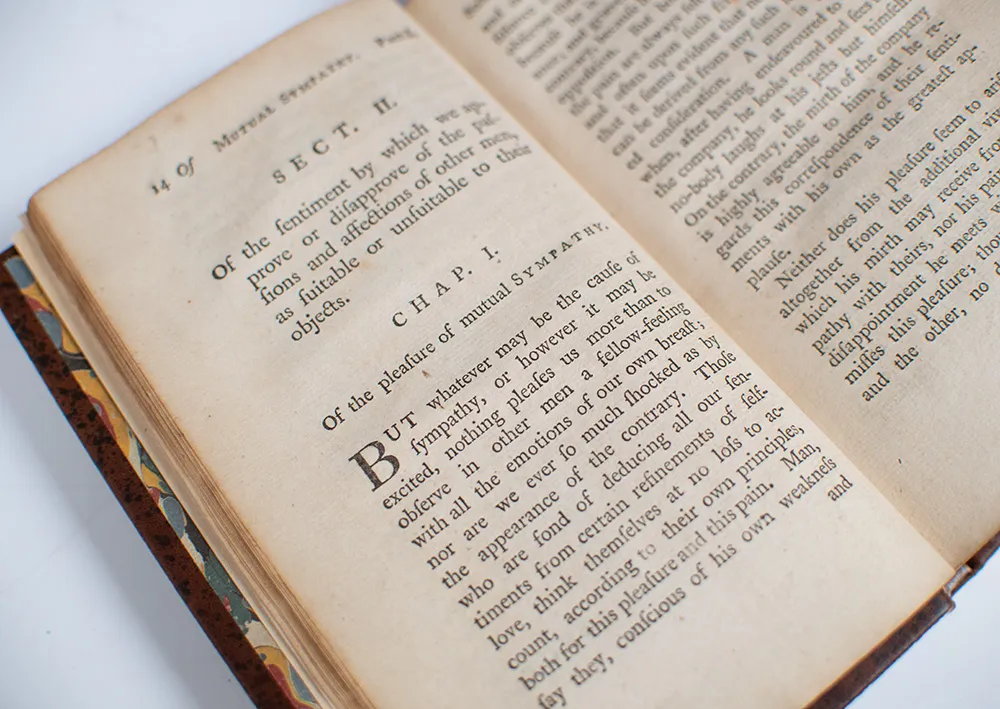
Photo: Raptis Rare Books
Social Justice and the Common Good
In his Nicomachean Ethics, Aristotle distinguishes between theoretical wisdom (sophia) and practical wisdom (phronesis), defining the latter as “a true and reasoned state of capacity to act with regard to the things that are good or bad for man” (1140b, 5-6). Pericles and his ilk, Aristotle writes, exemplify practical wisdom because “they can see what is good for themselves and what is good for men in general” (1140b, 9-10). In contemporary studies of wisdom, the Aristotelian dictum that it is “impossible to be practically wise without being good” reemerges as an insistence that wisdom implies actively working toward “personal and collective well-being,” informed by a “fundamental sense of justice,” attention to the “common good,” and an appreciation of our “shared humanity” (Aristotle 1144a, 36-7; Baltes and Staudinger 122; Stephen Hall 18; Sternberg and Glück Wisdom 1ff.; Grossman et al., “Science” 118). The practice of wisdom demands both social and emotional intelligence, an empathetic respect for the diversity of others, and a capacity for emotional self-regulation that furthers both personal and communal well-being. Where the practitioner of the paranoid style sees only aspects of the self in the outside world through what Freud called “projection”, wisdom “deepens with our awareness of the inherent tension between the inner ‘I’ and the outer world” in the pursuit of both personal and common goods (Stephen Hall 9).
Intellectual Humility
If wisdom studies’ insistence on the well-being of both one’s self and one’s community stems from Aristotle, its foregrounding of intellectual humility finds its philosophical forebear in Plato. In Plato’s Apology, Socrates speaks of interrogating a reputedly wise, unnamed politician, only to conclude that “I am wiser than he is to this small extent, that I do not think that I know what I do not know” (21d). In what has come to be called the humility theory of wisdom, wisdom accrues to those who not only know the limitations of their own knowledge, but are also conscious of limitations and uncertainties in the world at large. The wise value knowledge, but they also value appropriate doubt. Or as Barbara Tuchman writes in the essay with which I began, an “essential component of that ‘truest wisdom’ is the self-confidence to reassess” (7). Few Americans, let alone few American politicians, exemplify this “truest wisdom” better than Abraham Lincoln. Reflecting on the Gettysburg Address, Stephen Hall has eloquently written: “The genius of true humility, and its arterial attachment to wisdom, is in understanding the context of the moment, understanding one’s audience, and at the same time misunderstanding (perhaps deliberately) one’s own greatness” (145f.).
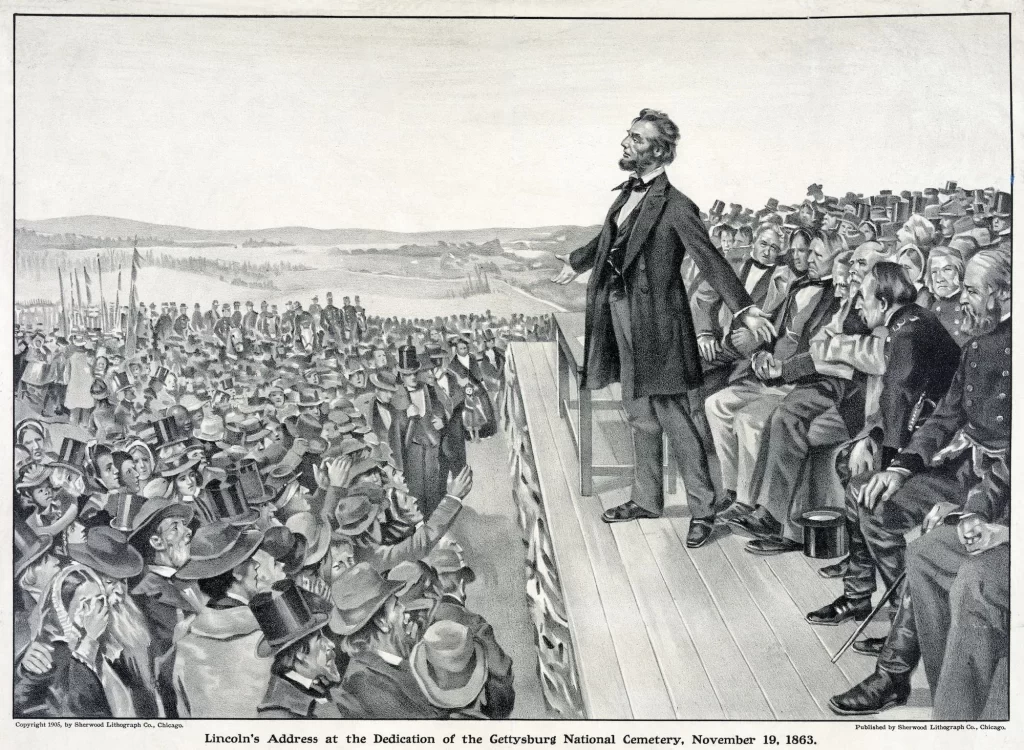
Photo: The Bristorian
In an important sense, intellectual humility is both a precondition to, and the result of, the prior four markers of wisdom. Understanding that our judgment is far from infallible and that there is always more to learn leaves us open to situational complexities, ambiguities, and uncertainties; to the experience of radically different cultural contexts; to empathy for others; and to concern for the common good. Fostering intellectual humility—both in ourselves and in others—thus initiates a virtuous circle, the result of which is a notable increase in wisdom.
To summarize: wisdom as I understand it is a capacity for sound judgment with a view to pragmatic action. Wise judgment is attuned to cognitive complexities in the world and to the ways in which historical and cultural contexts inform diverse systems of value. Whatever their domain of action, wise practitioners evince high degrees of intellectual humility and empathy, together with a thoroughgoing commitment to fostering the well-being of both one’s self and one’s community.
